Canada’s Defence Industrial Strategy: InDro’s View

Canada’s Defence Industrial Strategy: InDro’s View

By Scott Simmie


In a rapidly shifting geopolitical landscape, Canada has announced a forthcoming Defence Industrial Strategy (DIS). The initiative was first revealed by Federal Defence Minister David McGuinty in September of 2025. Its goal is to boost Canada’s defence and sovereignty capabilities – while simultaneously providing a runway and budget for made-in-Canada dual-purpose technology solutions. The country will be devoting five per cent of its GDP by 2035 as part of its NATO commitment, and the DIS will determine how to most effectively spend that money.

“This is a $9.2 billion investment which will strengthen our forces…enhance our infrastructure and boost our operational readiness….Every defence dollar spent is intended to reinforce Canada’s sovereignty, advance our national security, and fuel home-grown innovation,” said The Minister during a keynote speech at GCXpo, an exhibition featuring Canada’s technology leaders, with a focus on Small to Medium Enterprises (SMEs) and startups.

The Minister made it crystal-clear these companies will be front and centre in the forthcoming DIS, with significant spending allocated to developing dual-purpose technologies that will assist in Canada’s overall defence and sovereignty strategies. Those includes ground robotics, autonomous systems, drones, AI, cyber-security – and much more. The details of the DIS are being worked on now, but Minister McGuinty made one thing perfectly clear:

“This is what I do know, and for sure: I know that at the heart of the strategy is you. The innovators, the investors, the risk-takers, the entrepreneurs, and the startups. You’re going to help us develop the dual-use technologies that are going to shape the future of defence and security,” he said.

All of this, of course, marks an inflection point in Canadian policy. And it spells unprecedented opportunities for Canadian technology and R&D firms to assist in developing technologies that will help safeguard Canada’s future.

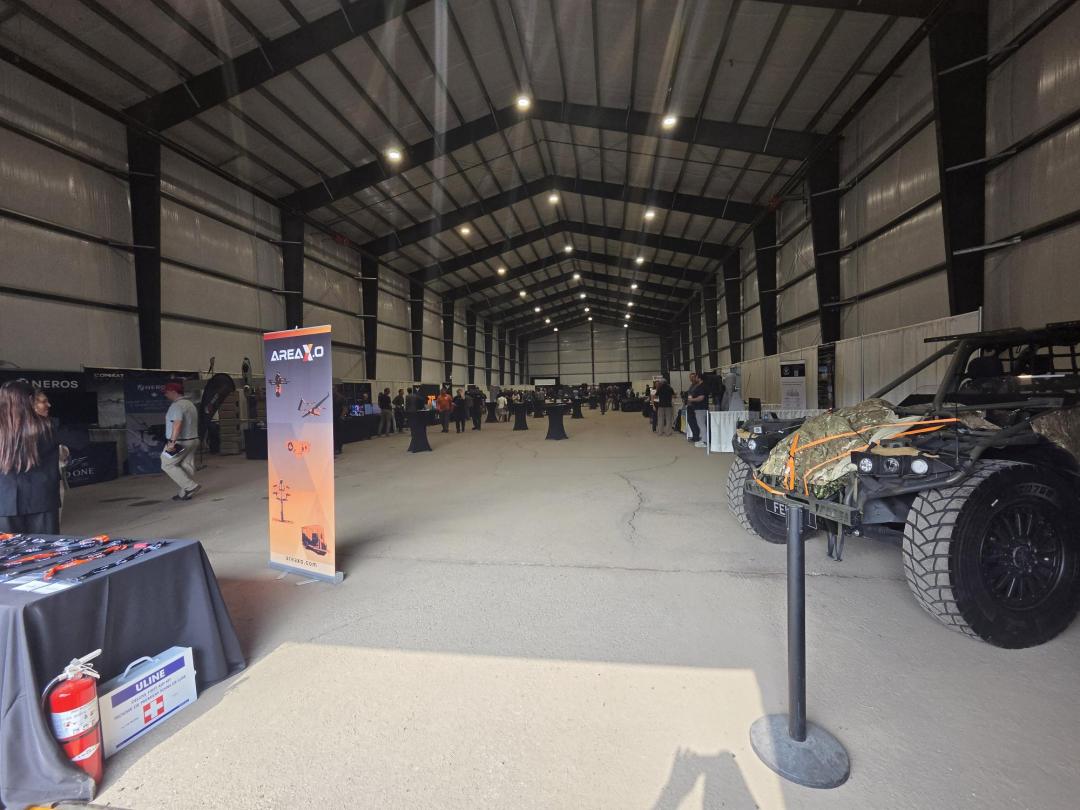
Above: Canadian Prime Minister Mark Carney meets with Ukrainian President Volodymyr Zelensky: Photo by Lars Hagberg. Below: The Honourable David McGuinty, Federal Minister of Defence, announces plans for the new Defence Industrial Strategy during a speech at Area X.O during the GCXpo event

David McGuinty

INDRO’S STRATEGY SUBMISSION


As a leading R&D company, InDro Robotics – and countless other Canadian technology firms – have a stake in how Canada’s Defence Industrial Strategy takes shape. We are intimately familiar with existing government incentives and procurement processes. We know what works – and are eager to see the Federal Government implement an accessible, thoughtful and accountable strategy. As a result, we thought it prudent to prepare a submission to the House of Commons Standing Committee on Industry and Technology, which is conducting a study on how best to draft and implement the DIS.

Our submission recognises, as the Honourable David McGuinty pointed out, that Canadian SMEs must be at the core of this strategy. It we want truly sovereign defence capabilities we must look to domestic solutions, Canadian intellectual property, and strengthened Canadian supply chains.

A robust Defence Industrial Strategy, we argue, must allow Canadian SMEs to grow and scale. It should ultimately increase reliance on domestic innovation, while decreasing reliance on foreign contractors. We also suggest the DIS be structured in a manner where there’s a high degree of accountability, with measurable results and reviews to ensure objectives are being achieved and flexible enough that changes can be made over time to maximise its benefits.

Without a strategy that provides predictable procurement pathways, supports SME scale-up, and invests in dual-use innovation, the government risks falling short of its objectives,” we write in our introduction.

Canada’s allies already pair defence spending increases with targeted industrial strategies that bring emerging technologies rapidly into service and help domestic firms compete globally,” we continue. “The DIS is an opportunity to do the same: to build sovereign capability, strengthen supply chain resilience, retain intellectual property in Canada, and enable high-growth Canadian firms to scale into world leaders.”


RECOMMENDATIONS


In total, we make four recommendations.

The first is to prioritise SMEs as core contributors to the Strategy.

The DIS should explicitly identify SMEs as central to Canada’s sovereign defence and security capacity, with procurement, innovation programs, and industrial-development tools calibrated to grow and sustain a resilient SME ecosystem,” we write. 

Our second suggestion is that clear pathways be established to allow SMEs to scale up. We call, specifically, for “structured pathways” for high-growth SMEs to grow, with the ultimate goal that these SMEs will, over time, become primes within their technology verticals.

Our third recommendation is that the eventual Defence Industrial Strategy set aside “targeted, accessible, and adequately resourced funding mechanisms that enable SMEs to invest in R&D, certification, security clearances, manufacturing capacity, and export readiness.”

And finally, we respectfully emphasise the importance of evaluation and accountability after the DIS is deployed to ensure maximum effectiveness and impact.

The DIS should be subject to a mandatory biennial review, measuring progress against key performance indicators such as defence sector growth, SME participation rates, supply chain resilience, technology adoption, and contributions to Canada’s GDP. A joint report tabled in Parliament by the Ministers of Industry and National Defence would reinforce accountability and ensure the Strategy remains responsive, measurable, and execution focused.”

The quotes above are taken from our recommendations summary; we go into far greater detail on each of the four points. We see the eventual DIS as a critical blueprint not only for allowing dual-purpose innovations to flourish, but also as a key pillar in Canada’s defence and sovereignty in an increasingly uncertain world. We believe made-in-Canada solutions are imperative for this program to reach its long-term objectives.

Below: Our dual-purpose Cortex Lite brain box can be integrated onto any platform, enabling autonomous missions, remote teleoperation, seamless integration of any sensors – and much more. Platform-agnostic devices like these can be used in industrial, research, defence settings and more:


Cortex Lite

INDRO’S TAKE


These are, indeed, unprecedented times. Not only is the DIS on its way, but on December 1 Prime Minister Mark Carney announced that Canada has been included as a partner in a European Union program known as SAFE – Security Action For Europe. Canada is the only country outside of the EU with preferential access to this $244B program.

“SAFE is a force multiplier for Canada,” said Minister McGuinty. “Our participation in SAFE unlocks unprecedented opportunities for Canadian manufacturers to build what our Allies need and what our Forces can rely on. This partnership accelerates our own rearmament while showcasing the world-class capabilities of Canadian workers, engineers, and innovators.”

“We are in a very different world, and that world requires a broad range of new and innovative dual-purpose technologies,” says InDro Founder and CEO Philip Reece. “InDro Robotics, and the broader Canadian tech sector, are eager to offer existing and forthcoming innovations we believe will strengthen Canada’s defence and sovereignty, while also strengthening Canada’s economic base.”

We are hopeful the Committee working on the Defence Industrial Strategy takes a close look at our recommendations, which we believe are in the best interests of Canada. And we urge others in the sector to consider putting forward their own submissions to the House of Commons Standing Committee on Industry and Technology in the hope the very industry the DIS will rely on can help shape this critical piece of policy.

CBC Interviews InDro Founder/CEO Philip Reece on the new Federal budget

CBC Interviews InDro Founder/CEO Philip Reece on the new Federal budget

By Scott Simmie


Canada’s new budget was unveiled Monday, November 4.

Delivered by Finance Minister François-Philippe Champagne, there was a lot of focus on technology and defence – both for global competitiveness and to reflect a changing geopolitical world. CBC carried extensive live coverage of the event, which included an interview on the program The House with InDro Founder and CEO Philip Reece on a panel.

The headline for the tech sector? A massive investment in defence spending, which includes dual-purpose technologies, meaning they can be utilised both for defence and industrial/civilian purposes. And the money? It’s big, including $81.8B over five years to rebuild, rearm, and invest in the Canadian Armed Forces.

Here’s a breakdown:

  • $17.9 billion over five years to expand Canada’s military capabilities including investments in additional logistics utility, light utility, and armoured vehicles, counter-drone and DRONE long-range capabilities, and domestic production, among other investments.
  • $6.6 billion to support the Defence Industrial Strategy
  • $6.2 billion over five years to expand Canada’s defence partnerships, including military assistance to Ukraine.

The Defence Industrial Strategy is new – and Canada’s first-ever such strategy. Details will be released in the coming months. But during the recent GCXpo in Ottawa, Defence Minister David McGuinty explained that it will lean heavily on Canada’s technology innovators.

“This is what I do know, and for sure: I know that at the heart of the strategy is you. The innovators, the investors, the risk-takers, the entrepreneurs, and the startups. You’re going to help us develop the dual-use technologies that are going to shape the future of defence and security,” he said.

Below: Dual-purpose technologies, such as our Sentinal inspection robot, could play a significant role in Canada’s Defence Industrial Strategy.

Industrial Inspection Robots

CANADA STRONG


It was clear from Finance Minister François-Philippe Champagne’s opening remarks that this would be a very different kind of budget.

“The world is undergoing a series of fundamental shifts at a speed, scale, and scope not seen since the fall of the Berlin Wall,” he said.

“The rules-based international order and the trading system that powered Canada’s prosperity for decades are being reshaped – threatening our sovereignty, our prosperity, and our values….Budget 2025 represents the largest defence investment in decades.”

And perhaps most revelant for this sector?

“With our new Defence Investment Agency and Defence Industrial Strategy, we will build up Canada’s defence industry – strengthening Canadian businesses and supporting Canadian workers…We will further build our security and defence capabilities, right here at home – creating new jobs for our engineers, technicians and scientists in sectors such as aerospace, shipbuilding, cybersecurity, and AI.”

In many ways, the budget signified that Canada is at a critical turning point. And while it wasn’t all focused on defence and innovation, there was a striking emphasis on these areas. And that means challenges – and opportunities – right across the entire technology sector.

This is about more than one company; it’s about building a Canadian defence ecosystem,” says Reece. 


INNOVATION IN A CHANGING WORLD


The world is changing in unprecedented ways. The stability of geopolitics we’ve traditionally enjoyed is now much more uncertain. Significant conflicts, using newer technologies, are in the news every day. So it was no surprise the Canada Strong budget emphasized this country needs to advance its capabilities.

Following the budget, CBC’s The House interviewed a panel that included InDro Robotics Founder/CEO Philip Reece for his reaction from the technology sector. He started by touching on the budget’s potential to help grow SMEs, which are really the backbone of bringing new technologies to the fore.

“This budget is a strong start for that,” he said. “Now…we need the Canadian government to follow through and allow innovators like InDro – and the many others that are out there – to really compete and become those global companies that we deserve to be.”

Part of that plan will be contained in the forthcoming Defence Industrial Strategy, which will be released in the months to come. As previously hinted by Canada’s Minister of Defence, this strategy will rely heavily on technology entrepreneurs ranging from startups and SMEs through to major corporations. 

InDro Robotics invents and manufacture technologies that have already assisted the Department of Defence and have carried out work directly for the Ministry. (Most recently, InDro and partner CHAAC Technologies carried out a demonstration for the DoD of an AI land mine detection project that fuses drones, ground robots, and a neural network.)

Devices like our dual-purpose Sentinel inspection robot can be put to work in the field for reconnaissance, and our InDro Cortex greatly enhances the capabilities of a wide range of existing devices – including military vehicles and drones. We also have extensive expertise in customised drone and Counter-UAS technologies.

“It’s the same kind of technology now that can be rapidly swapped over to defence,” Reece told The House. “And we have seen that sort of build over the last couple of years, but it needs to build faster. 

“InDro Robotics is ready to deliver on Canada’s defence vision. We have the tech, the talent, and the ambition, now we need a clear path from government that allows us to grow and meet the moment,” says Reece.

Below: Philip’s interview on CBC’s The House, followed by an image of our Cortex – a dual-purpose InDro innovation that can be used for defence, industrial and civilian purposes

InDro Cortex ICRA 2025

INDRO’S TAKE


It is indeed a changing world. And we’re pleased (and relieved) to see the Government of Canada recognise the important role that technological innovation will play in our future sovereignty and security. InDro Robotics, and many other tech companies in this country, are ready to answer this call.

“The Canada Strong budget marks a pivotal moment for Canada’s defence and economic resilience,” says InDro Robotics Founder/CEO Philip Reece.

“InDro Robotics welcomes the increased investment and urges the government to now deliver a clear strategy to help Canadian businesses grow into true global leaders, capable of supplying the men and women of the Canadian Armed Forces with the tools and equipment they need and supporting Canada’s trade diversification goals. It is indeed a challenge, and we are up for it.”

We look forward to the forthcoming details of Canada’s Defence Industrial Strategy, and will update you at that time.