

By Scott Simmie
We were tempted to use the word “infinite” in the headline above.
Because really, when it comes to customising a robot or industrial drone into pretty much any configuration, our InDro Cortex (hardware) and InDro Controller (software) can handle the task. A one-off wheeled quadruped for autonomy research at an academic institution? Check. A humanoid carrying out pick-and-place work in a factory setting? Check. A wheeled or tracked ground robot carrying out regular autonomous inspections on remote assets? Check, check, and check.
Once you factor in the growing number of sensors, platforms and use-cases, the potential combinations run into the thousands (if not more). We are pleased to confidently state that the synergy of InDro’s Cortex and Controller can handle virtually all of them.
Why so confident? Let’s find out.
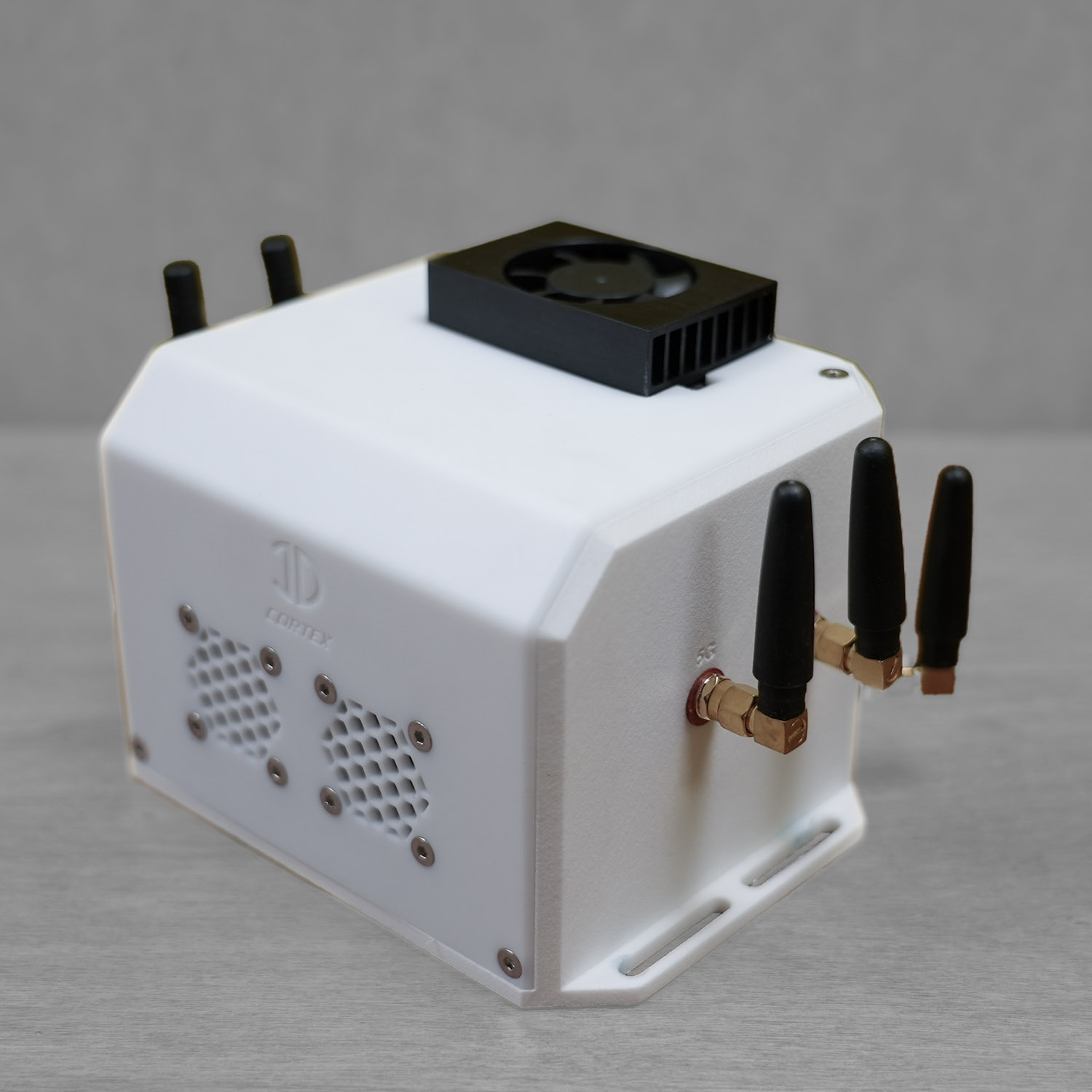
Above: A fleet of AgileX platforms, all outfitted with InDro Cortex, InDro Controller, and multiple sensors before shipment to a client. Below: The tiny but powerful Cortex
WHAT IS INDRO CORTEX?
The simple answer is that it’s an incredibly powerful yet very small brain box and sensor interface that can be mounted on any robotic platform. It can transmit data over 5G networks with imperceptible lag and receive instructions from a remote operator. Measuring 11cm x 14cm x 10cm, and weighing a mere 679 grams, Cortex has been designed from the ground up – including custom PCBs – by our engineering team. It’s platform-agnostic, meaning you can use it with virtually any robotic framework.
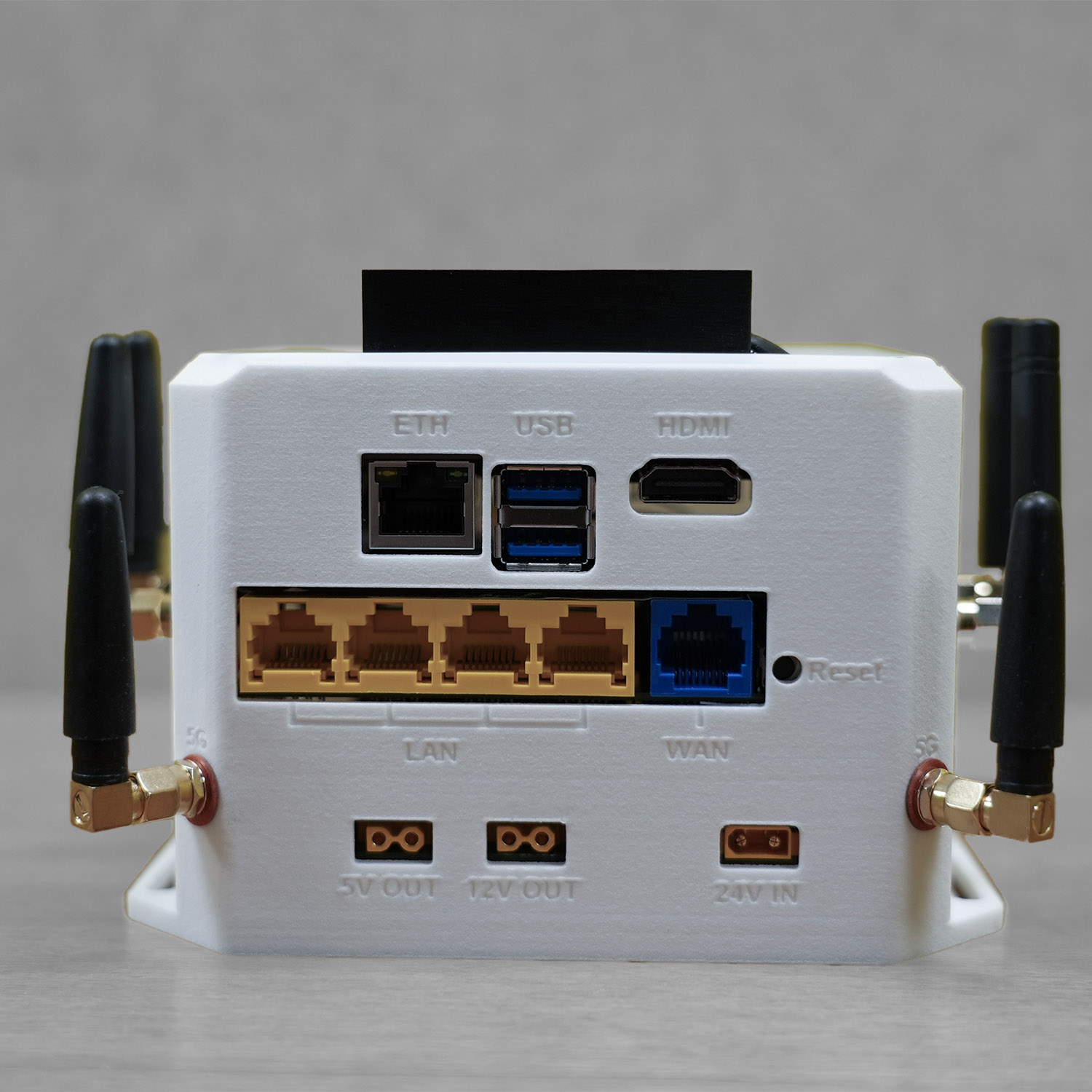
Sensor integration – and the fusion of sensor data – is a breeze, With multiple I/O and power options, you simply plug & play. That’s because Cortex is preloaded with ROS2 Humble, which contains all the software tools, libraries, drivers, and communication protocols that allow for near-instant integration of any and all sensors. Power supply for those sensors is provided by Cortex (which is powered by the platform itself).
Looking for the compute required for seamless sensor fusion and demanding AI applications? You’ve got it: Our base Cortex comes with a processor capable of 100 TOPS (trillions of operations per second). If your use-case or application demands more powerful compute, we’ll happily upgrade that to your requirements.
Running on Ubuntu 22.04 LTS paired with ROS2 means Cortex is ideally suited for robotics work. That duo have become the standard for most robotics companies, R&D organisations and academia. (LTS, by the way, stands for Long-Term Support, meaning Cortex receives regular security, maintenance and other Ubuntu updates as they’re released).
For communication, Cortex ships with a small but powerful 5G modem, allowing you to remotely control your robot (and see all the data) with nearly imperceptible lag. It can operate on public or private 5G networks, as well as over WiFi. Clients sometimes purchase Cortex and Controller (which we’ll get to shortly) as a standalone and integrate their own robots. Others buy the pair as part of a custom robotics package we design and integrate. Several years of intense research have gone into building Cortex – which is now one of InDro’s core products.
Below: Just one example of a potential package where all sensors integrate with Cortex, though we frequently build far more complex systems. Image two shows the multiple I/O options that come on our standard Cortex

CORTEX AND CONTROLLER – A PERFECT PAIR
Imagine our Cortex hardware as a Formula One car. Now picture InDro Controller software as the driver and pit crew.
While InDro Cortex processes vast quantities of data at high speeds, InDro Controller allows you to see that data and control the robot. Using a highly secure desktop interface created by our front-end development team, Controller offers an intuitive dashboard that allows you to carry out operations in three ways: Manually, autonomously with pre-programmed waypoints, and even in GPS-denied environments using LiDAR SLAM or vSLAM.
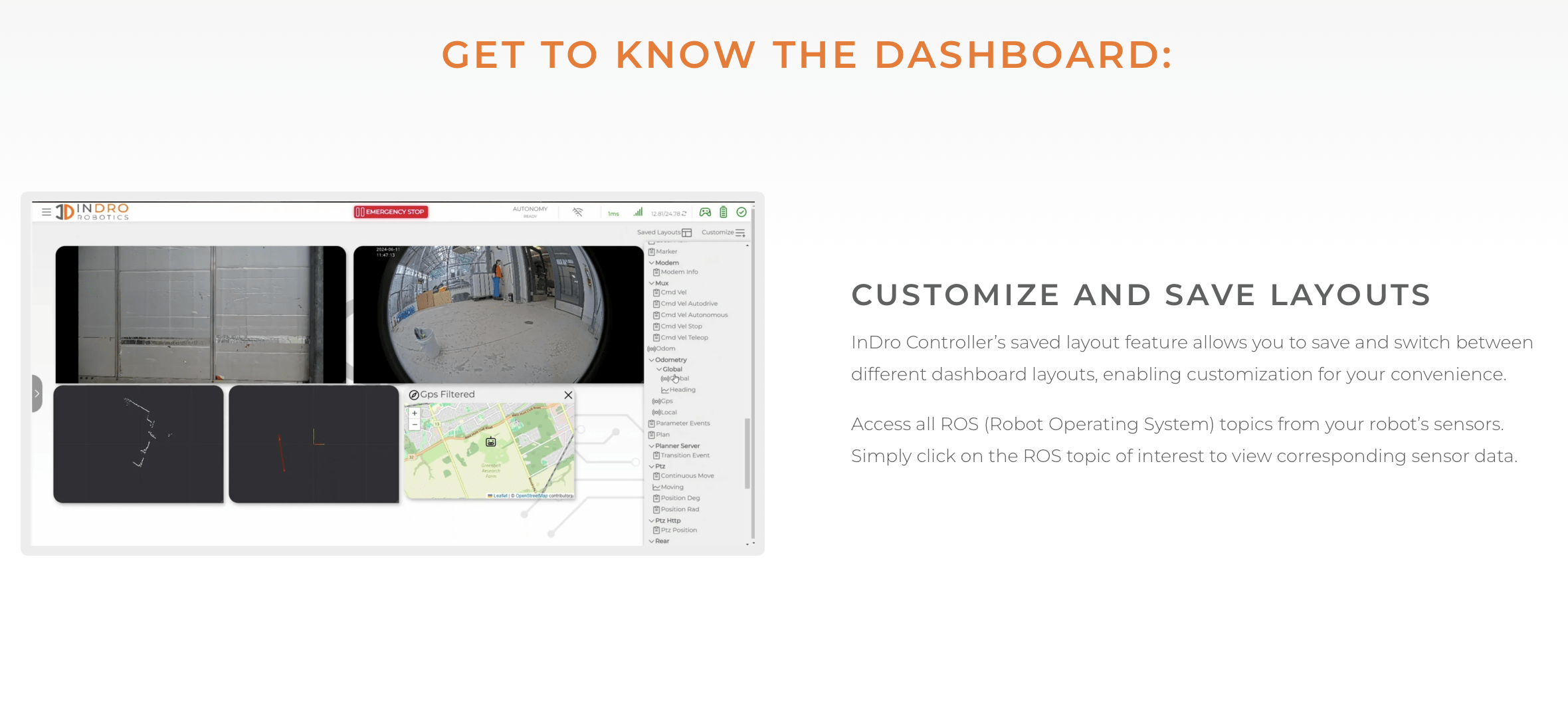
With multiple sensors running on a given robot (or drone), the dashboard allows you to easily move and size windows for data display and location. You can program waypoints at the click of a mouse, and have a robot carry out specific tasks at each waypoint. For example, you could have a PTZ camera tilt and zoom in on a specific gauge to read it, or stop and check on a component where a temperature change might indicate trouble. You can save endless missions and set them to run automatically at desired intervals.
The InDro Controller software lives onboard Cortex; you simply type in the URL associated with your robot and the encrypted login display pops up.
Our InDro Autonomy software stack is optional (though popular). But, as with Ubuntu LTS, users can rely on long-term support and upgrades from InDro. If we tweak something to improve a feature of InDro Controller (or any of our other software stacks), clients get that upgrade. InDro stands behind its products and ensures our users can maximise their potential.
Below: Just one of many custom views on the InDro Controller dashboard
INDRO’S TAKE
You’ve heard the metaphor – the one about “standing on the shoulders of giants.” In this case, Cortex is the logical successor to our highly successful InDro Commander. Released more than three years ago, Commander was a breakthrough in simplifying the integration of R&D robots and for custom builds. Now, after several years of work, Cortex is the logical successor. It’s smaller, more powerful, and comes with the highly evolved InDro Controller.
“Cortex is the result of a tremendous amount of R&D from our Area X.O engineering team,” says InDro Robotics Founder and CEO Philip Reece. “It not only greatly simplifies building complex robots, but can vastly enhance robotic platforms ranging from engineering research robots through to military defence platforms. It, along with Controller, will be core InDro products for many years to come.”
To learn more about InDro Cortex and Controller, drop a line to our Head of R&D Sales, Luke Corbeth. He’s a no-pressure pro who loves talking about use-cases and solving problems.