

By Scott Simmie
It’s been quite a journey.
Since the founding of InDro Robotics by Philip Reece back in 2014, the company has followed a steady trajectory of innovation and growth, marked by multiple milestones and a number of industry “firsts.” We thought, 12 years on, it was worth looking back on that path.
The company was initially formed after CEO Reece saw an opportunity. At the time, he owned Salt Spring Air, a small floatplane company later acquired by the Harbour Air Group. A regular client would hire one of his aircraft annually for aerial data acquisition – but this year declined, saying he was going to use a drone instead. Reece began researching drone technology and quickly identified this would be a growth market where R&D could play a role – both in enabling new technologies and new use-case scenarios.
“The economic benefits of a UAS versus traditional aircraft were immediately apparent,” he recalls. “And it was also clear there were multiple use-cases where a drone would be able to do things a crewed aircraft could not.”
And so InDro – short for Industrial Drones – was born. It was, initially, a startup operation based out of Salt Spring Island. Reece, along with a few dedicated staff, began building and testing drones (and also some uncrewed surface vehicles for aquatic work). Reece, a serial entrepreneur, had a knack for identifying novel use-cases.
“In 2014, in our very first year, we demonstrated that an Automated External Defibrillator could be delivered by drone, potentially saving lives,” he says.
For InDro, that trial marked the beginning of a strong and steady voyage.
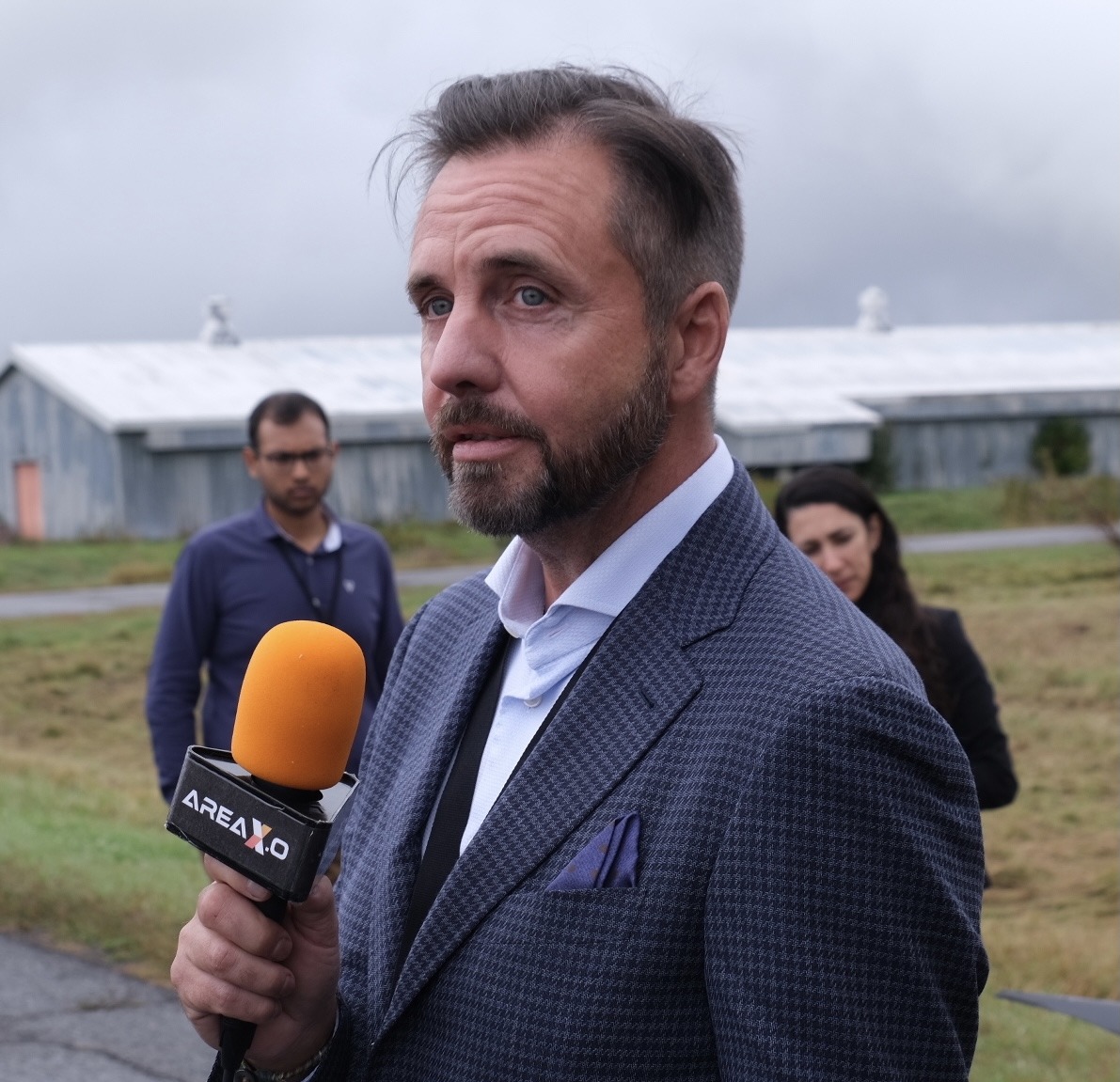
Above: Advanced urban wind tunnel research drone on a mission with the NRC. Below: A 2014 video (which now shows its age) where InDro demonstrated the potential for AED delivery by drone. Image: InDro Founder/CEO Philip Reece at Area X.O.
PROGRESS, COLLABORATION, MILESTONES
In those early days, regulators were exceedingly cautious, even fearful, of this new technology. There was legitimate concern a drone might collide with another aircraft, or cause injury to persons or property on the ground. You couldn’t simply put a drone up in the air regardless of the purpose – you needed a Special Flight Operations Certificate (SFOC) for each and every flight. It was a time-consuming process.
But Reece, a licensed pilot himself, could see the rationale and began building trust with contacts at Transport Canada. InDro also started working with a broad selection of First Responders – fire, police, Search & Rescue and more – training them how to safely use these new tools. At one of the biggest downtown fires in Victoria’s history, the fire department deployed an InDro-supplied drone with a FLIR thermal camera. It allowed the department to see through thick smoke to more strategically direct suppression efforts.
While Visual Line of Sight flights (with an SFOC) could accomplish many tasks, Reece and others in the industry knew that BVLOS flights would open up an entire new world of use-cases. In 2016, in coordination with Transport Canada and First Responders, InDro flew a BVLOS mission to assist with a major forest fire. That was within restricted airspace and a special case. But the company did fly Canada’s first BVLOS mission outside of a test range in 2017.
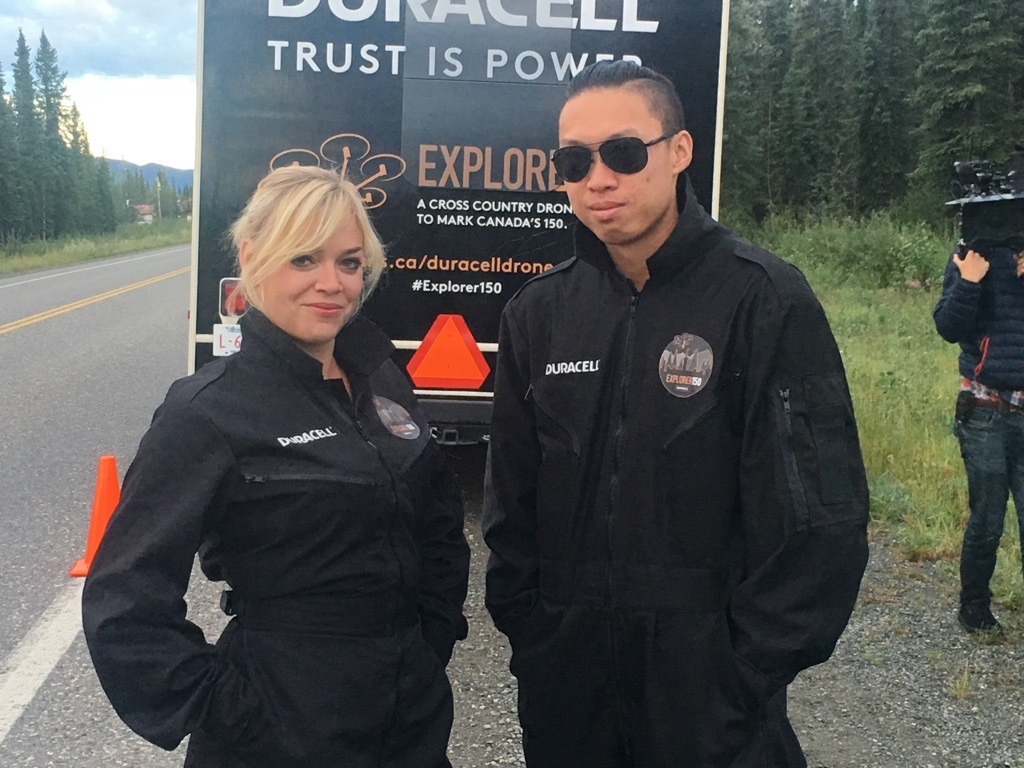
We also flew regularly from a moving vehicle to document the beauty and diversity of this country during an 11,000 km overland trip through Canada in the Explorer 150 project – a partnership with Maclean’s magazine, Duracell and Rogers, and one of many high-profile events to mark Canada’s 150th birthday. We even captured video of polar and grizzly bears during that trip.
Below: Two members of the Explorer 150 team
OTHER FIRSTS
There are many. Highlights include:
- The first “blanket” SFOC for Canada-wide flights, and the first license granted by the Canadian Transportation Agency to use drones as a means of cargo delivery
- The first flight in Canada using 5G for Command and Control (2021)
- The first TC BVLOS delivery of simulated blood products between hospitals (2018) and the first delivery of pharmaceutical products (2019) with privacy and other approvals. Those trials, along with further research work transporting AEDs, proved that aerial delivery was faster than emergency ground transport
InDro rapidly developed a reputation not only as a serious player in this emerging industry, but a collaborative one. In 2018, Reece worked closely with regulators and Canada Post to arrange for a demonstration of drone technology and BVLOS flights from the-then Salt Spring Island headquarters. He invited multiple companies – including AVSS, ParaZero Technologies, Avidrone Aerospace, SkyX, DJI and Iris Automation (since acquired by uAvionix) to highlight their own solutions, all observed by Transport Canada and NAV CANADA officials, as well as senior Canada Post management. Those invitations made that event about elevating the industry, not InDro.
It was that kind of work that garnered InDro Robotics and Reece the prestigious Organisational Award from Unmanned Systems Canada (now the Aerial Evolution Association of Canada) in 2020. The award recognises a company that has made an outstanding contributions to the industry-at-large.
Below: Two use-cases we’re particularly proud of: During the peak of the COVID pandemic, InDro flew BVLOS flights for an island-based First Nations community, shuttling COVID test kits and swabs needing analysis back and forth to the mainland. We earlier flew Canada’s first BVLOS deliveries of prescription medications in a fully sanctioned trial
INDRO’S TAKE
Other firsts include working with telecoms like Rogers to carry out Canada’s first flight over 5G. We developed InDro Pilot, then InDro Controller, as a UI for command and control. We’ve collaborated with Federal departments like the National Research Council, detected landmines in partnership with Montreal’s CHAAC technologies for the Department of National Defence, and built multiple generations of R&D drones that run on the open-source ROS2. We remain the key technology provider for the ongoing Drone Detection System at YOW, which has gathered years worth of data shared with Transport Canada, NAV CANADA, the RCMP and other airport authorities. (The system was even used to ensure the airspace was free of drones for former US President Joe Biden’s visit to Ottawa.)
We’ve also helped incubate other companies, including Cypher Robotics, which has a tethered drone attached to an autonomous mobile robot that counts warehouse inventory with 99-plus per cent accuracy. Plus many projects for international clients where we are bound by NDA.
This story could be much longer – there’s a lot we’ve skipped, including the launch of the FLYY online drone training portal – but you get the drift: InDro has continuously pushed the envelope with drone technology and use-cases, collaborating whenever possible while developing custom RPAS solutions for global clients.
“In retrospect, I’m incredibly grateful that client decided to not hire a Salt Spring Air floatplane back in 2014,” says Reece. “That was where all this started, and I could not have envisioned back then how this path would unfold. Our engineering staff has grown immensely since the early days, and we’re now innovating with long-range, hybrid aircraft suitable for deliveries and reconnaissance in Arctic conditions.”
And one more very important thing before we wrap:
“None of this would have been possible without a dedicated engineering team and the support from multiple Federal and provincial programs that believed in us. As a company we are grateful for that trust – and look forward to what’s next.”
Part II of this series is coming soon: InDro and ground robotics.