
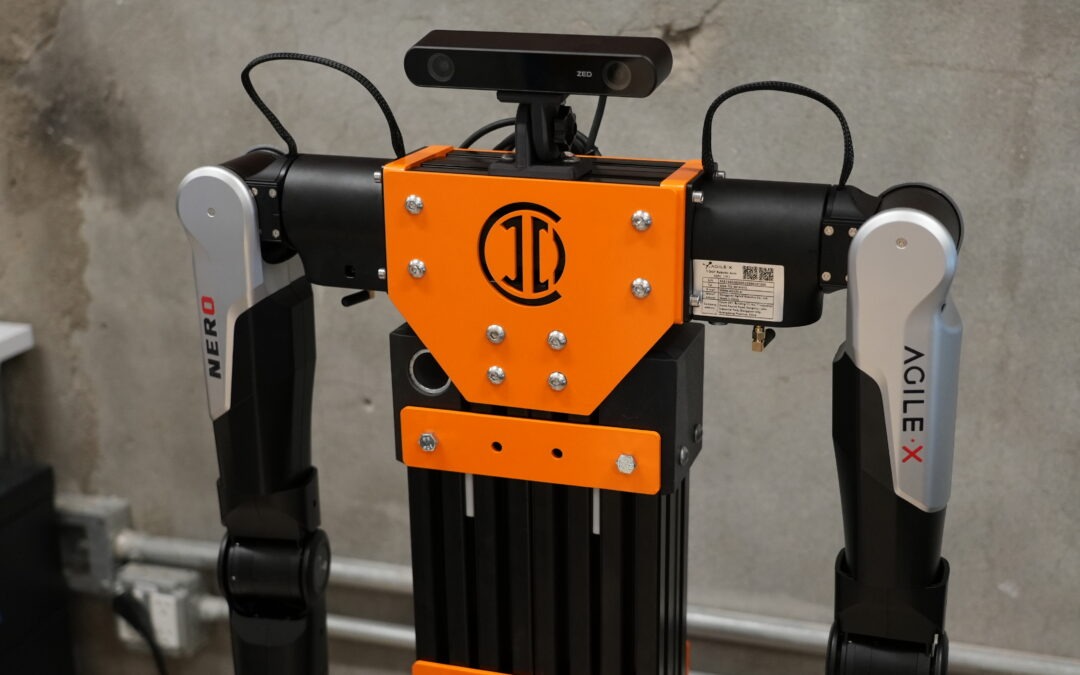
Meet the New InDro Axiom Humanoid-Style Research Robot
By Scott Simmie
We’ve released a new robot – and it’s unlike anything we’ve built before.
The new InDro Axiom is a budget-friendly and flexible platform for those doing Physical AI R&D involving humanoid-style robots with arms. It’s designed to make advanced robotics more accessible to researchers, academic institutions, and industry.
Created in response to growing demand for affordable humanoid development tools, Axiom provides many of the capabilities researchers require for manipulation, simulation, and autonomy development — without the cost or complexity associated with fully bipedal humanoid systems.
“We describe Axiom less as a robot and more as a research solution with exciting industrial implications,” says Luke Corbeth, InDro’s Head of R&D Sales. “It’s a budget humanoid — an adaptable, modular approach to Physical AI. It gives researchers a way to collect data, develop skills, and build toward autonomous deployment using one flexible system.”
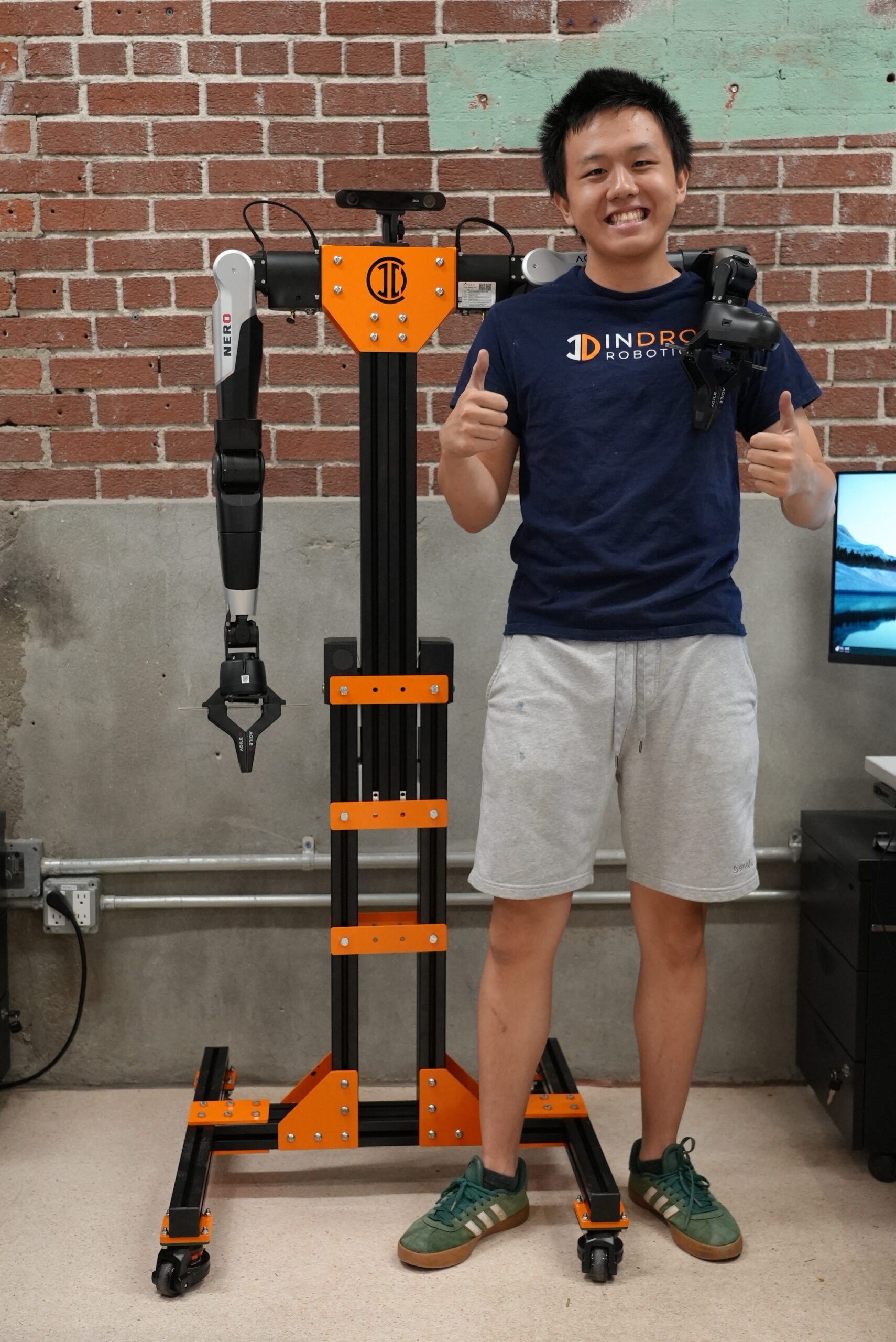
Below: The human-height Axiom alongside Robotics Hardware Engineering Intern Justin Luo
TELESCOPING TORSO
Those doing research with humanoids – and ultimately deploying them in the real world – need a platform with arms. And those arms might need to reach something high, low, or in-between. Axiom can handle them all.
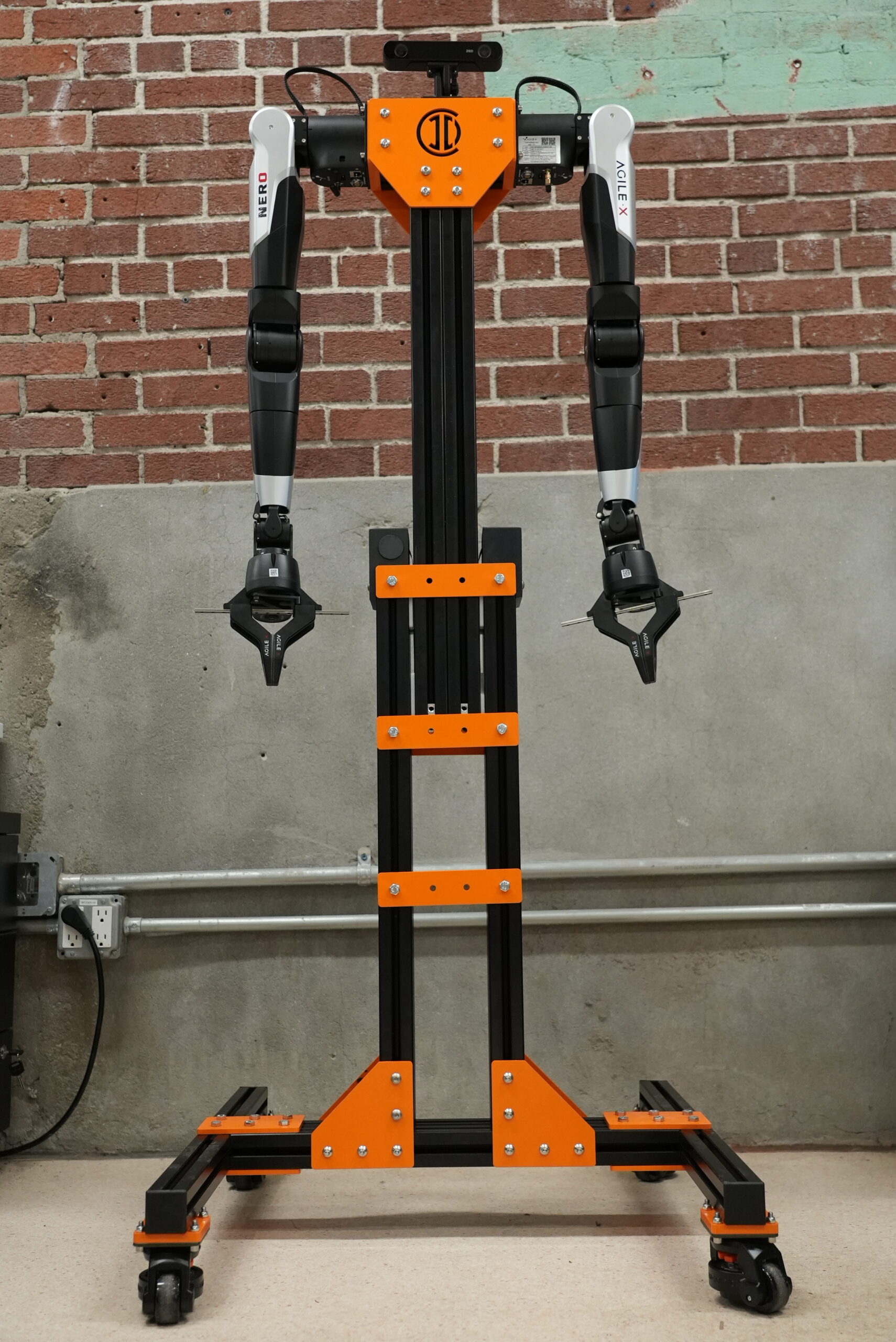
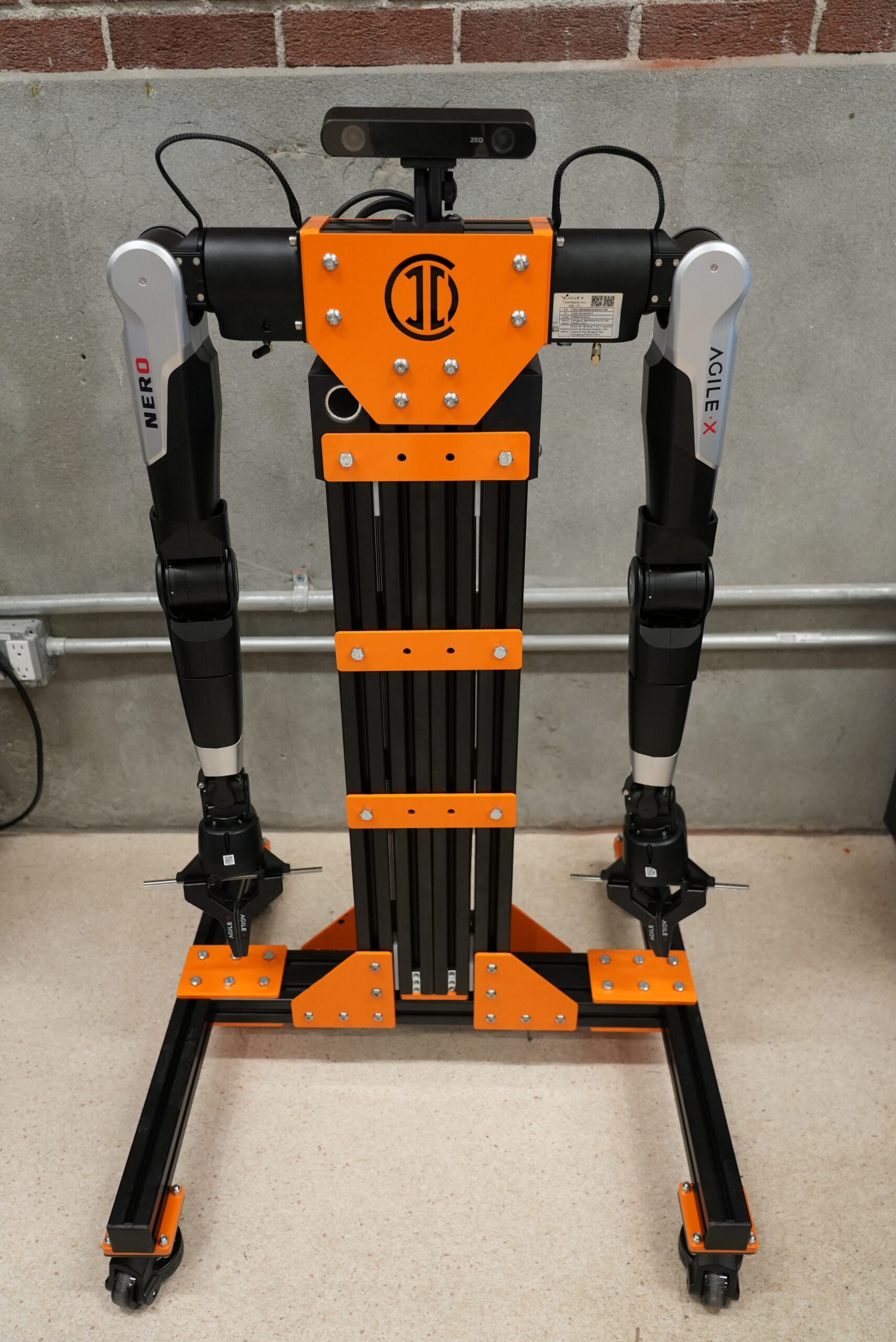
Axiom features a unique form factor that includes a telescoping torso, caster-wheel base, dual shoulder-mounted robotic arms, and a top-mounted depth camera. Users can move the platform to wherever the research or work needs to take place. The adjustable torso enables Axiom to function across a wide range of environments – from tabletop tasks to higher interactions such as cabinets, shelves, or door handles. Customers can select their own robotic arms and end effectors. If you already have robotic arms, you can purchase a base model with depth camera for $4,000 US and integrate your own hardware.
Axiom is aimed at robotics researchers exploring Physical AI — the emerging field where artificial intelligence moves beyond software and into machines that carry out tasks in the physical world.
“Physical AI is what happens when you give an intelligent system the ability to perceive and act,” says Corbeth. “Instead of generating answers like an AI chatbot, the system learns to actually perform tasks in the real world.”
UPGRADES AVAILABLE
To maximize accessibility, Axiom can operate as a standalone development platform using a researcher’s existing computer workflow. For more advanced applications, it can be equipped with InDro Cortex for onboard compute and connectivity, along with InDro Controller for visualization, simulation, remote operation, and advanced autonomy development.
The platform expands to match your needs. Axiom can be integrated onto an Autonomous Mobile Robot (AMR) base, adding omnidirectional movement and creating a fully mobile manipulation research platform which could ultimately be deployable.
Corbeth says the timing for Axiom is perfect.
“Physical AI is one of the most exciting frontiers in robotics right now,” he says. “This isn’t science fiction anymore – it’s happening today in labs around the world. Axiom is another way InDro is helping enable that future.”
Below: Axiom’s adjustable torso means the robot swiftly be set to different heights
INDRO’S TAKE
Axiom grew from customer demand, and three units have already shipped. A typical system with two highly capable arms runs about $19,000 USD and, when equipped with InDro Cortex and InDro Controller, about $28,000 USD.
“Researchers have told us they want to work on humanoid-style development, but a $60,000 to $100,000 system simply isn’t realistic for many teams,” says Corbeth. “Axiom creates a much more accessible pathway.”
InDro Founder and CEO Philip Reece is pleased the company can offer such an affordable platform for research.
“Physical AI is already much more than a buzzword,” he says. “Axiom now allows academic and R&D companies to affordably develop algorithms and other innovations that will fully enable the next generation of humanoid-style robots.”
For more information about InDro Axiom, contact Luke Corbeth.