
By Scott Simmie
Wildfires are a growing threat.
You might think, based on media coverage, that we’re having more of them. That’s not always the case; in some areas the number of wildfires is down. The real problem is that wildfire outbreaks in recent decades have become more intense: Larger, hotter, and spreading more rapidly. Scientists examining data from NASA’s Terra and Aqua satellites gathered over 21 years found that “the frequency of extreme events increased by 2.2-fold from 2003 to 2023, with the last seven years including the six most extreme,” says a study published by Nature.
NASA sums up the problem like this: “Extreme wildfires have become more frequent, more intense, and larger. The largest increase in extreme fire behavior was in the temperate conifer forests of the Western U.S. and the boreal forests of northern North America and Russia,” it writes. “Warmer nighttime temperatures are a major contributing factor, allowing fire activity to persist overnight.”
Traditionally, we’ve used satellite data, weather forecasts and observable conditions on the ground to try to gauge risk. But our response has generally been reactive; rushing to contain and extinguish once a wildfire is underway, or rapidly evacuating communities once a fire is approaching.
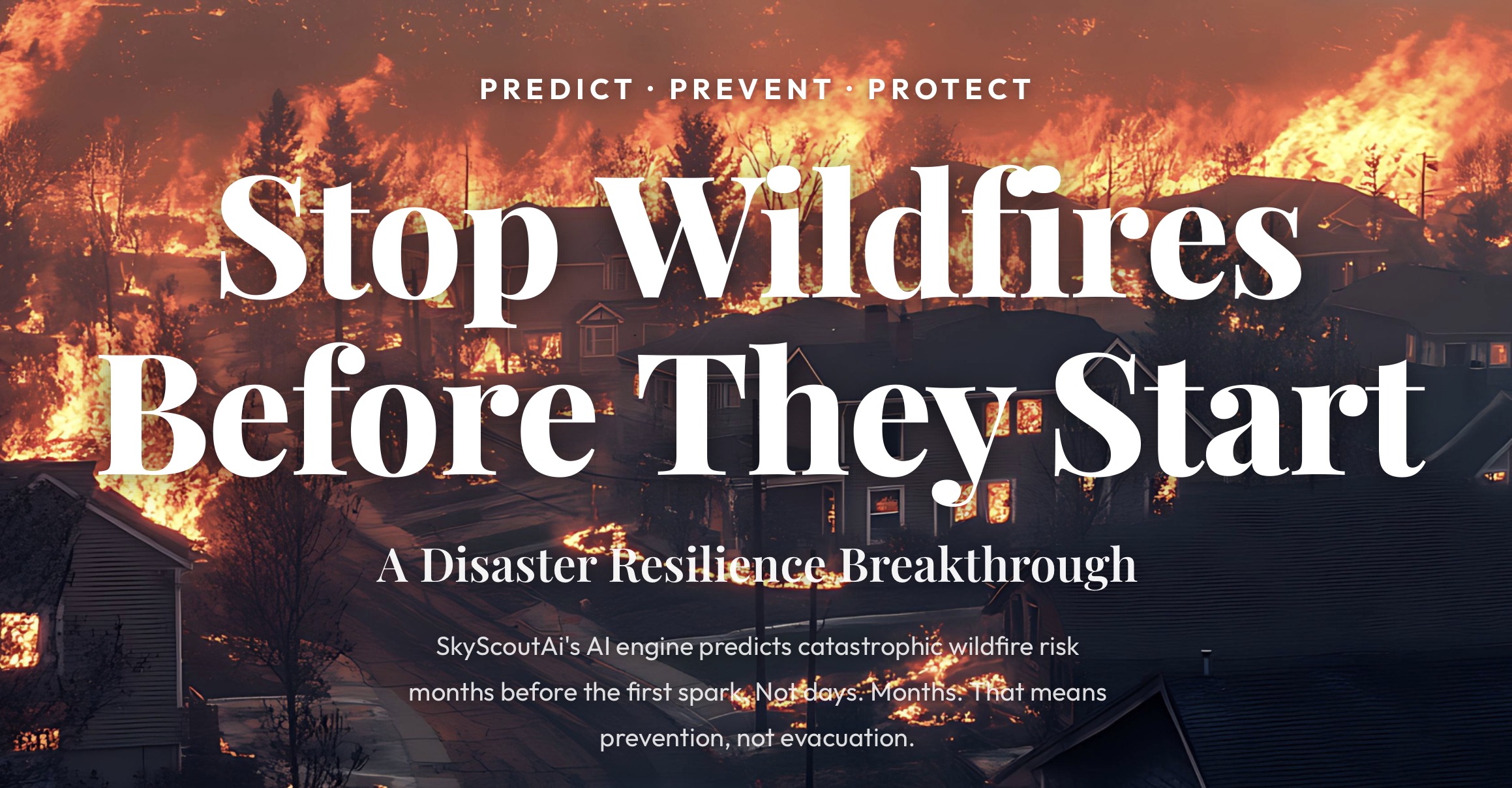
Now, Canadian tech company SkyScoutAI says it has a better way. With the tagline “Predict * Prevent * Protect”, SkyScout says its system fuses ground sensors, satellite imagery, historical data, specific terrain features, drones and a powerful AI engine to produce an evidence-based score of the real-time threat to any given area where the system is deployed.
It’s a bold claim. But, given the Chief Technology Officer’s commitment to this field – which includes nearly a decade of research into using drones and AI specifically for wildfires – it’s clear there’s a ton of science it.
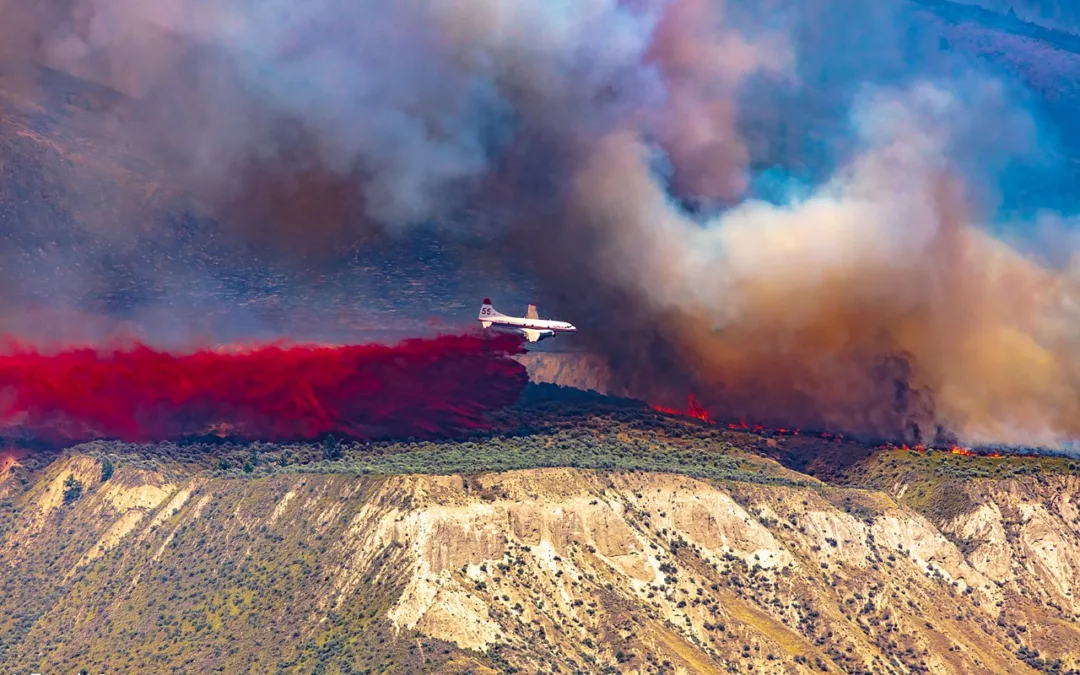
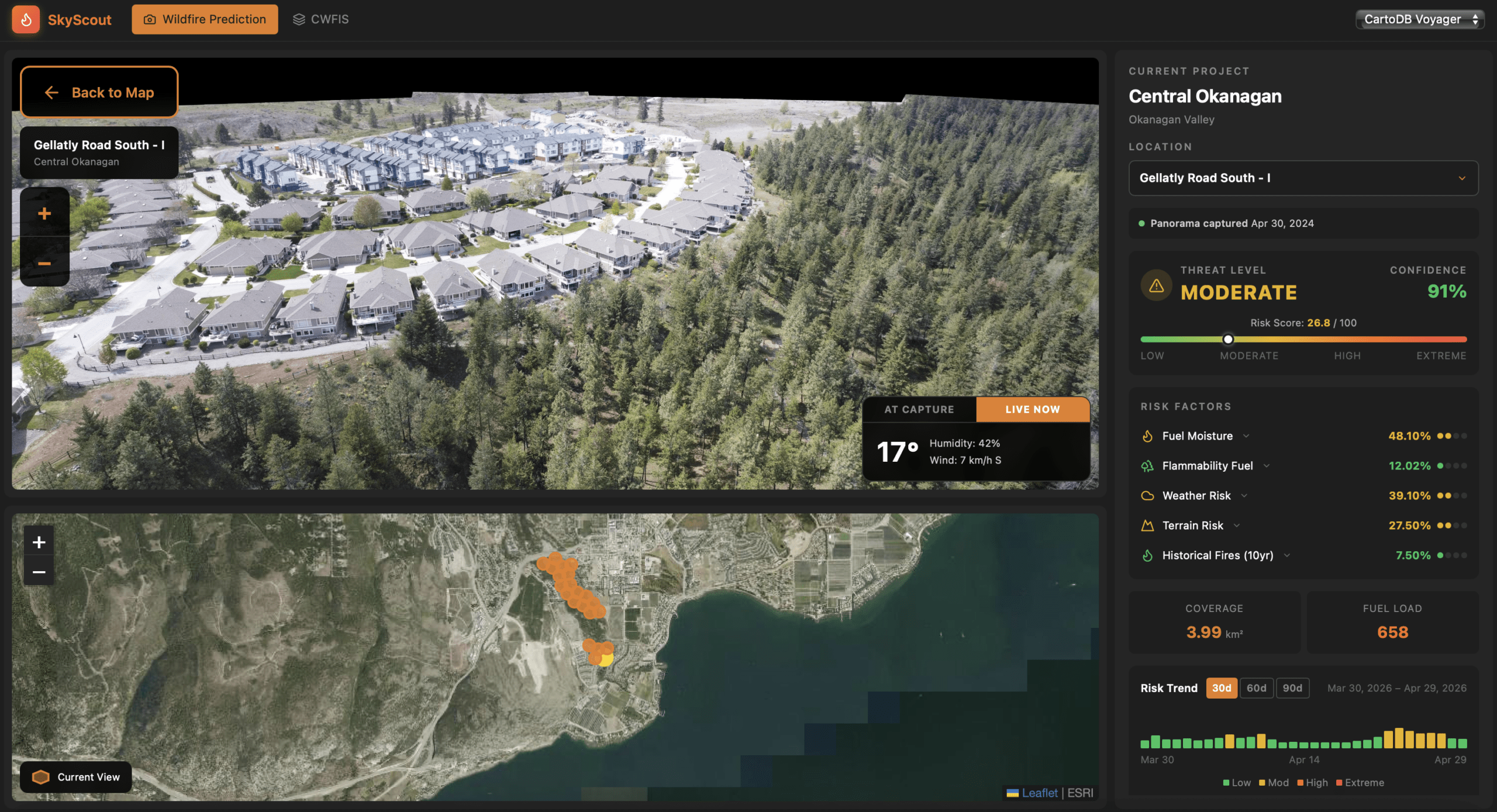
Above: A fast-moving wildfire east of Kamloops, BC in 2018. Photo by Murray Foubister via Creative Commons Share Alike 2.0. Below, a screengrab from SkyScoutAI.com
MULTIPLE DATA POINTS AND POWERFUL AI
A key component of the SkyScoutAI system is the person who helped devise it. Chief Technology Office Michal Aibin holds both a PhD and is Head of the British Columbia Institute of Technology’s Master of Science Program in Applied Computing. He’s been researching the use of drones and AI for wildfires since 2017, and now has graduate students assisting in that research. For Michal, trying to find a solution to this problem isn’t simply an engineering challenge; it’s personal.
“What I really wanted to do with my research at BCIT is something that can make a change for the community, to the lives of people,” he says.
With a background in AI, he started by looking at existing methods of predicting wildfires and thinking: There must be a better way.
“We noticed there are lots of things on the detection side of things…detection of the fire, wildfire assessment, change detection – but there’s not that much on the prediction and prevention side,” he says. “So the question that came in the initial phases of research was: ‘What can we do six months or 12 months in advance to learn what the fire season will look like?’ And this is where the idea of prevention and fuel measurement and using different sensors and putting all of these into some comprehensive risk prevention management tool came into action.”
One of the things he noted early on is that wildfires “don’t just happen – they develop,” By this he’s referring to a cascade of factors or events that ultimately culminate into conditions that are a Perfect Storm for wildfires.
How dry is it? What’s the fire history in this location? How dense are the trees? Is there a water source nearby? Structures? What’s the immediate forecast and what are the historical weather patterns? Is the terrain likely to speed the spread of a wildfire?
Beyond its core algorithmic engine, SkyScout AI uses ground sensors to capture real-time microclimate data across monitored areas. For aerial imagery, the company partners with InDro Robotics for drone operations and regulatory compliance, and with Spexi to obtain the resulting high-resolution captures. SkyScout AI then assembles and processes that imagery internally, feeding it into their wildfire prediction and risk analysis pipeline.
SkyScoutAI’s proprietary AI engine takes all that disparate data and fuses it together to produce an easy-to-understand, actionable risk score. It has a very simple User Interface which includes data points at any given location, the threat level, and the confidence the AI has in its overall prediction (see below).
PREDICT, PREVENT, PROTECT
While SkyScoutAI’s system handles multiple variables, it can’t predict when a human being might accidentally (or even deliberately) cause an ignition. Nor can it say when an electrical line might arc, or where lightning might strike. But because it can predict threat levels with a high degree of confidence, decision-makers have a tool that allows them to prepare resources. Thermal-equipped drones can make regular sorties in high-threat areas and provide an early warning system is there is an ignition. That data – the precise GPS coordinates – can be relayed in real-time to First Responder partners for a pinpoint response before the fire gets out of control.
It all sounds good – great, even – on paper. But it’s another thing to prove this system in the real world. That’s precisely what’s happening right now, with SkyScoutAI deployed in multiple locations in BC. There are also discussions with contacts in the US. Once the system has proven its worth, says Michal, the hope is for the company to quickly scale.
“We are fully ready as a technology. Now we are looking for institutional adoption and government procurements,” he says. “Those are processes we obviously don’t control. But we really hope that in two or three years we’ll be talking about SkyScoutAI as a tool known not only Canada-wide, but worldwide.”
Below: Michal Aibin speaks about SkyScoutAI on a recent edition of the SoundByte micro-podcast
INDRO’S TAKE
We’re big fans of SkyScoutAI – and not simply because we’re handling the drone and regulatory end of things. We’ve seen the utter devastation wildfires can cause too many times – to communities, to our forests, and to our environment and atmosphere itself. We also believe in the power of data, and the ability of SkyScoutAI to draw on multiple data points for continuous real-time threat-levels makes a lot of sense to us,
“Wildfires cause billions of dollars in damage annually, yet we’ve never had a reliable, data-driven way to predict threat levels,” says InDro Robotics CEO Philip Reece, who is also a Member of the Board of SkyScoutAI.
“This integrated system, which continuously evaluates multiple data points to produce reliable threat scores and confidence levels, will assist decision-makers in their allocation of resources to those areas most at risk with advance warning. Wildfires will continue to happen, but SkyScoutAI now provides an early warning system that should reduce their impact.”
Seeing is believing. We encourage you to check out SkyScoutAI’s dashboard, which includes live imagery and threat detection in multiple locations where it’s deployed, right here.