
By Scott Simmie
Picture a world where long-haul passenger jets are powered by liquid hydrogen – modified engines burning the gas the same way they used to combust Jet A fuel. There is zero CO2 produced. With the exception of some nitrogen oxides (due to higher combustion temperatures), the only exhaust is water vapour. For an even cleaner, zero-emission process, imagine a short-haul hybrid turboprop using fuel cells to power batteries and electric motors. You could even use hydrogen to run a generator for hybrid propulsion of long-range drones or UGVs.
Providing the hydrogen is obtained in a sustainable way, such as using wind- or solar-powered electrolysis, this chemical element could be the path toward a net-zero emission future in not only the aviation sector, but many others as well.
That’s certainly the future H2CanFly, a non-profit national R&D and commercialisation initiative with some 45 partners in industry and academia, would like to see. Its vision? “Working together to build safe sustainable, and equitable aviation solutions for a cleaner world.”
Sounds ideal. But it’s not a simple or easy path, particularly when it comes to passenger-carrying aircraft.
“Aviation is the most challenging industry to de-carbonize, and sector growth is anticipated to out-pace typical incremental efficiency improvements. Clean sheet designs take time, and the technologies that enable these designs must be advanced now to achieve our net-zero objectives by 2050,” states the H2CanFly website.
We spoke in-depth with H2CanFly CEO Eric Lefebvre, and will extract some key nuggets from that conversation. But first, a brief video from H2CanFly partner Airbus that lays out in simplest terms how using green hydrogen for aircraft and vehicles might someday look (and note the blended-wing aircraft in the video).
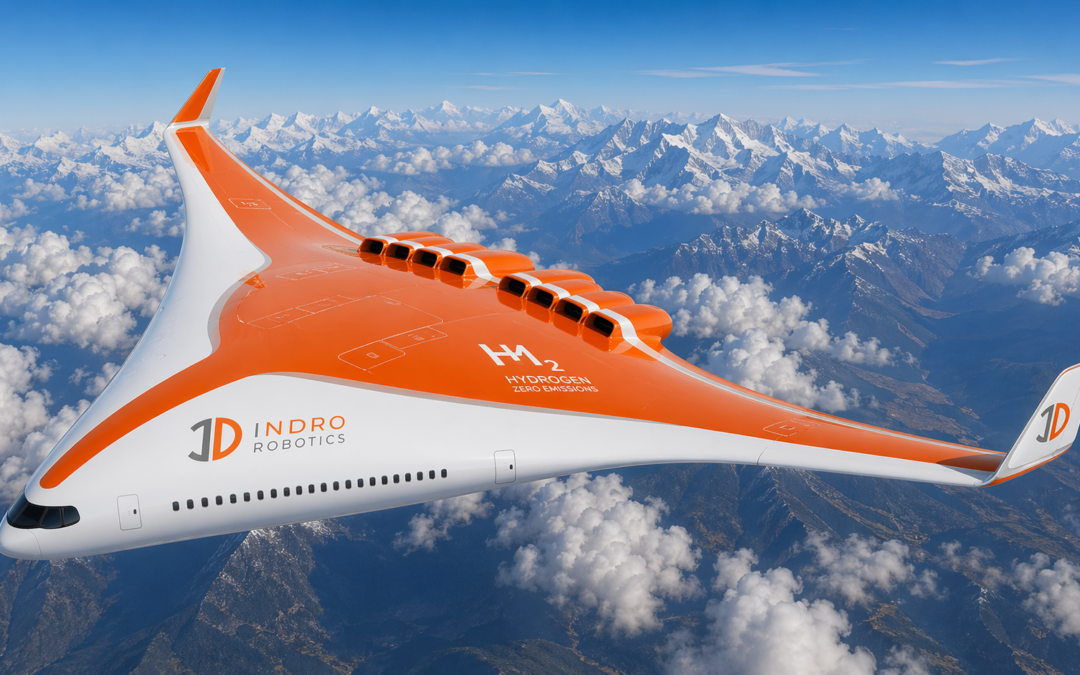
Above: We have no plans to produce a hydrogen jet. But by the year 2050, the odds are good a blended wing like this could be in the skies – albeit with different livery.
THE HYDROGEN ADVANTAGE
Why use hydrogen rather than gasoline or jet fuel? The obvious answer is to reduce the carbon footprint of everything from drones to ground vehicles to large passenger aircraft. Lefebvre, and many others, believe hydrogen is the clear solution.
“Hydrogen has a bright future in terms of its scalability, cost factor, its energy density, its gravimetric density, and so forth,” he says. “There are a lot of key applications that will benefit from the use of hydrogen. But there needs to be work – and it needs to be concerted and organized in order to bring about the desired R&D outcomes.”
That’s where H2CanFly comes in. The not-for-profit organisation has several major OEM partners, including Airbus, Boeing, CAE, Ballard and more. There are multiple SMEs, including InDro Robotics onboard. Others from the aviation sector, such as Edmonton International Airport, the Ontario Aerospace Council, and the Canadian Airports Council are involved. Plus there are several partners in academia, including the University of Waterloo, Concordia University, UBC and more. With so many high-level, vested partners on board, there’s the potential for real momentum (you can find a partner list here).
In addition to being a voice of the industry, H2CanFly is very much involved with trying to shape the next steps of the hydrogen evolution in Canada. That means working directly with partners on real-world R&D projects, carrying out research at its newly announced ARCTIC (Aero Research & Clean Tech Innovation Centre) lab at Aéroports de Montréal’s YMX Innovation Centre, conversing frequently with regulators – and orchestrating multiple (and complementary) R&D efforts in a unified way to push the needle forward in Canada.
A CHALLENGING, BUT NECESSARY STEP
Integrating hydrogen as a combustible fuel on a long-range passenger aircraft is not an easy task. It would involve liquid hydrogen, which would have to be in cryogenic tanks (there’s also research underway into binding hydrogen atoms with another material to create solid hydrogen, but that’s a topic for another day).
Those cryogenic tanks are not practical for storage in the wings, so in most designs they either sit aft of passengers (which means reducing seats or extending the body), or in a newer design such as a blended-wing craft. Commuter aircraft and regional feeders would likely use fuel cells producing electricity to power electric motors. Most existing fuel cells aren’t suitable for long-range flight with larger aircraft due to their weight and power output limitations (though there are steady improvements).
But the push is on. And Canada’s National Research Council says H2CanFly is playing a critical role:
“Decarbonizing aviation is a critical component of Canada’s goal of meeting net-zero greenhouse gas emissions and making the sector more sustainable,” states the Council’s 2025-2026 Departmental Plan.
“The H2CanFly consortium is set to transform the aviation industry by fast-tracking the commercialization of hydrogen propulsion aircraft to reduce aviation’s climate impact and strengthen Canada’s position as a global leader in the field. This partnership network, uniting key stakeholders from industry, academia and government, will build an inclusive and accessible national hydrogen flight research platform to achieve critical environmental and economic objectives for Canada.”
There are certainly hurdles ahead. It can take many years for new aircraft designs to be certified, and – for the aerospace industry – the bottom line is always important. The cost of sustainable, “green” hydrogen will have to come down (and the consensus is it will). There are also global and regional regulations/agreements requiring aviation carriers to achieve net-zero carbon emission by 2050 – and hydrogen seems to be the solution of choice.
The two videos below both provide excellent overviews of what’s ahead, with the second being longer and more in-depth. If you’re pressed for time, check out the first one (though they’re truly both worth a watch).
INDRO’S TAKE
InDro Robotics has long supported a sustainable future, so the widespread possibilities offered by hydrogen are of great interest to us. In fact, we’re currently working on a project with partners that involves a proof-of-concept for delivering hydrogen fuel in the field to RPAS and uncrewed ground vehicles.
“With concerns over greenhouse gases and a changing global climate, now is definitely the time to be exploring renewable propulsion systems and infrastructure for the future,” says InDro Robotics Founder and CEO Philip Reece. “We are pleased to be working with Eric Lefebrve and H2CanFLy on not only a sustainable future, but one where Canadian innovations in the hydrogen sector have an opportunity to be put to use globally.”
You can listen to our conversation with Eric, who appeared on a recent episode of our SoundByte micro-podcast, right here.