Police drone collision raises questions

Police drone collision raises questions

By Scott Simmie


There’s no question that drones have become an essential tool for First Responders.

They’re used to assess fires, document accidents, search for missing people and even get a sense of damage following a natural disaster like a tornado.

They’re also used by police on occasion to actively search for a suspect trying to evade capture. In such scenarios, you can imagine that officers might be highly focussed on apprehending the suspect.

That may have been a factor in an incident that occurred August 10, 2021. It involved a York Regional Police officer with an Advanced RPAS certificate, a DJI M210…and a Cessna. The incident is outlined in detail in a new Transportation Safety Board report.

(If you’ve read the report and just want to hear our take, skip to the end.)

Police Drone Collision

What happened


On August 10, 2021, a student pilot and flight instructor were in a Cessna 172N on a typical training flight. They were on final approach to Runway 15 at Toronto/Buttonville municipal airport. And then, in the words of the TSB report, this happened:

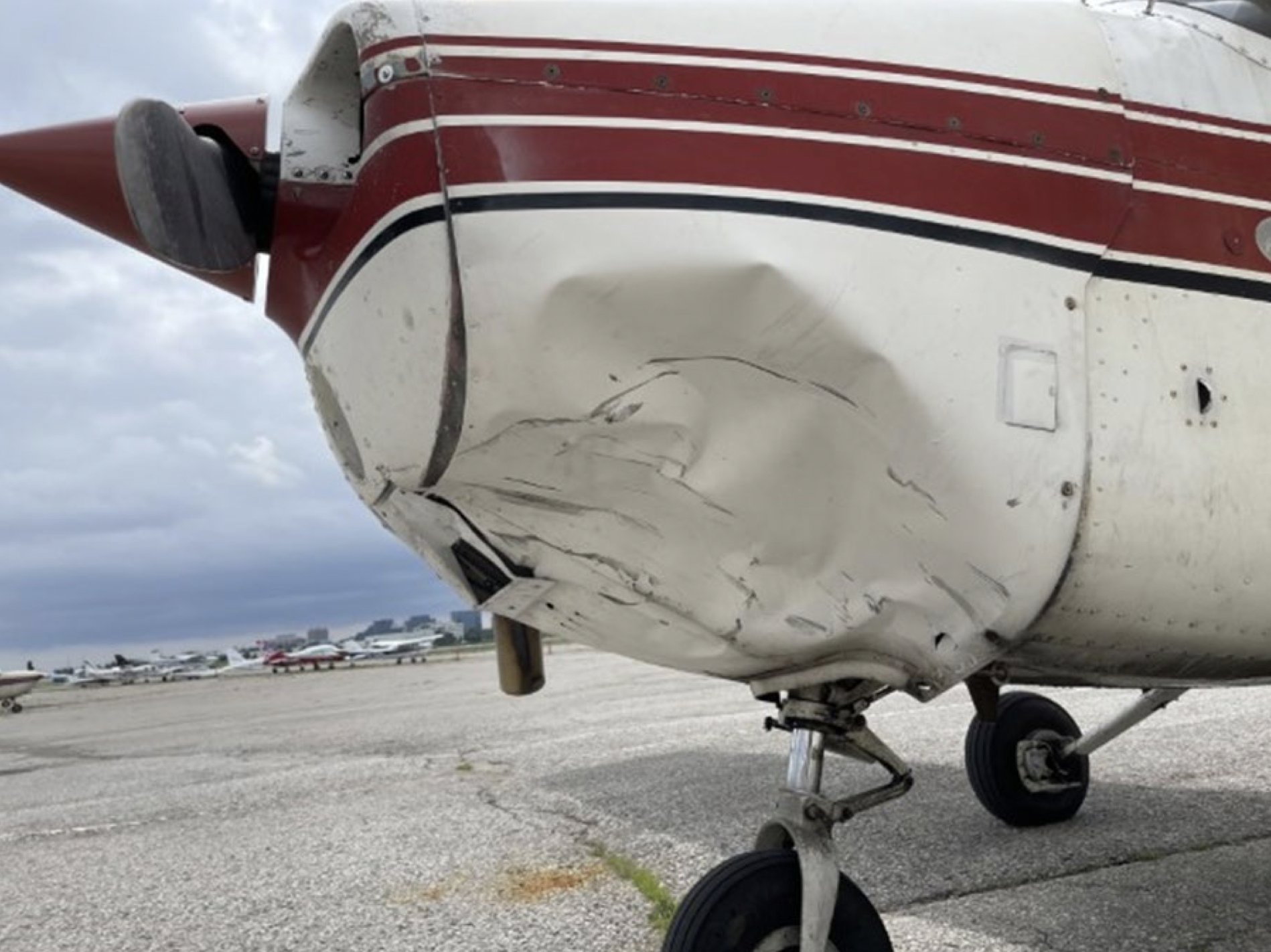
At approximately 1301 Eastern Daylight Time, the student pilot and flight instructor heard and felt a solid impact at the front of the aircraft. Suspecting a bird strike, they continued the approach and made an uneventful landing, exiting the runway and proceeding to park on the ramp. After parking the aircraft, they observed damage on the front left cowl under the propeller; however, there were no signs that a bird had struck the aircraft.

So what did?

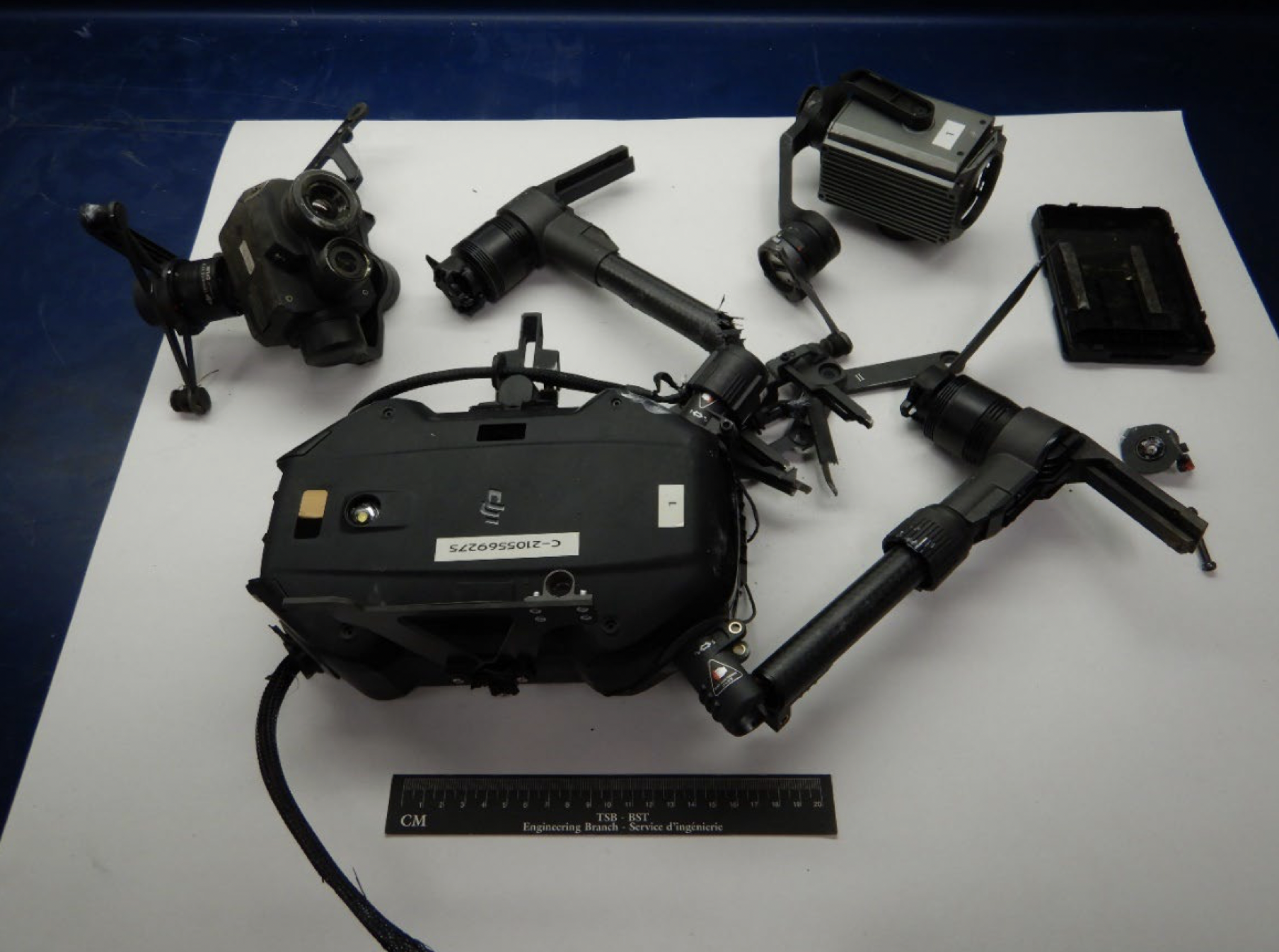
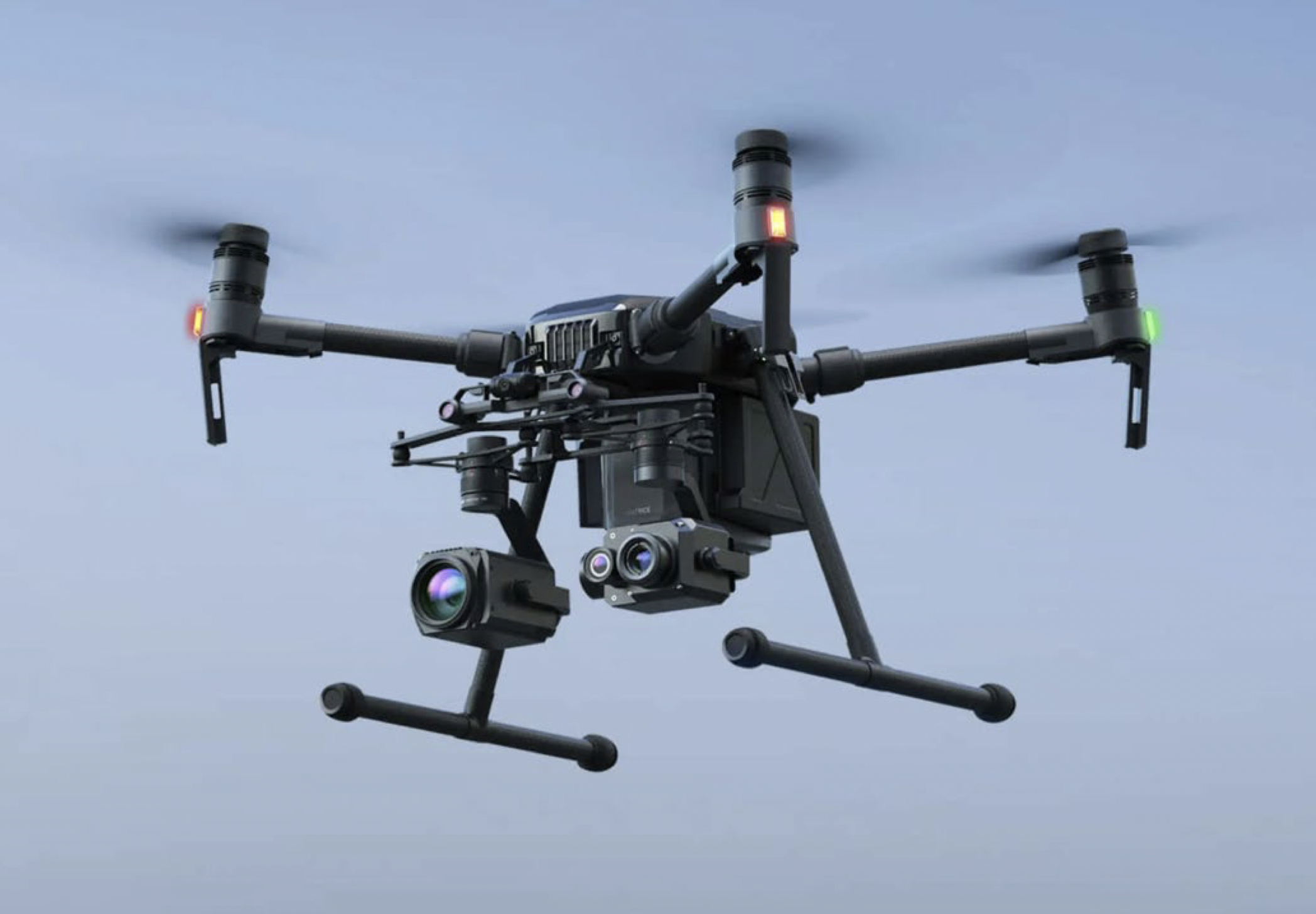
Shortly afterward, a member of the York Regional Police reported to airport staff that he believed a collision had occurred between the remotely piloted aircraft he had been operating and another aircraft. The remotely piloted aircraft, a DJI Matrice M210 (registration C-2105569275), had been in a stationary hover at 400 feet above ground level when the 2 aircraft collided. The DJI Matrice M210 was destroyed.

There were no injuries to either pilot on the Cessna 172N or to persons on the ground.

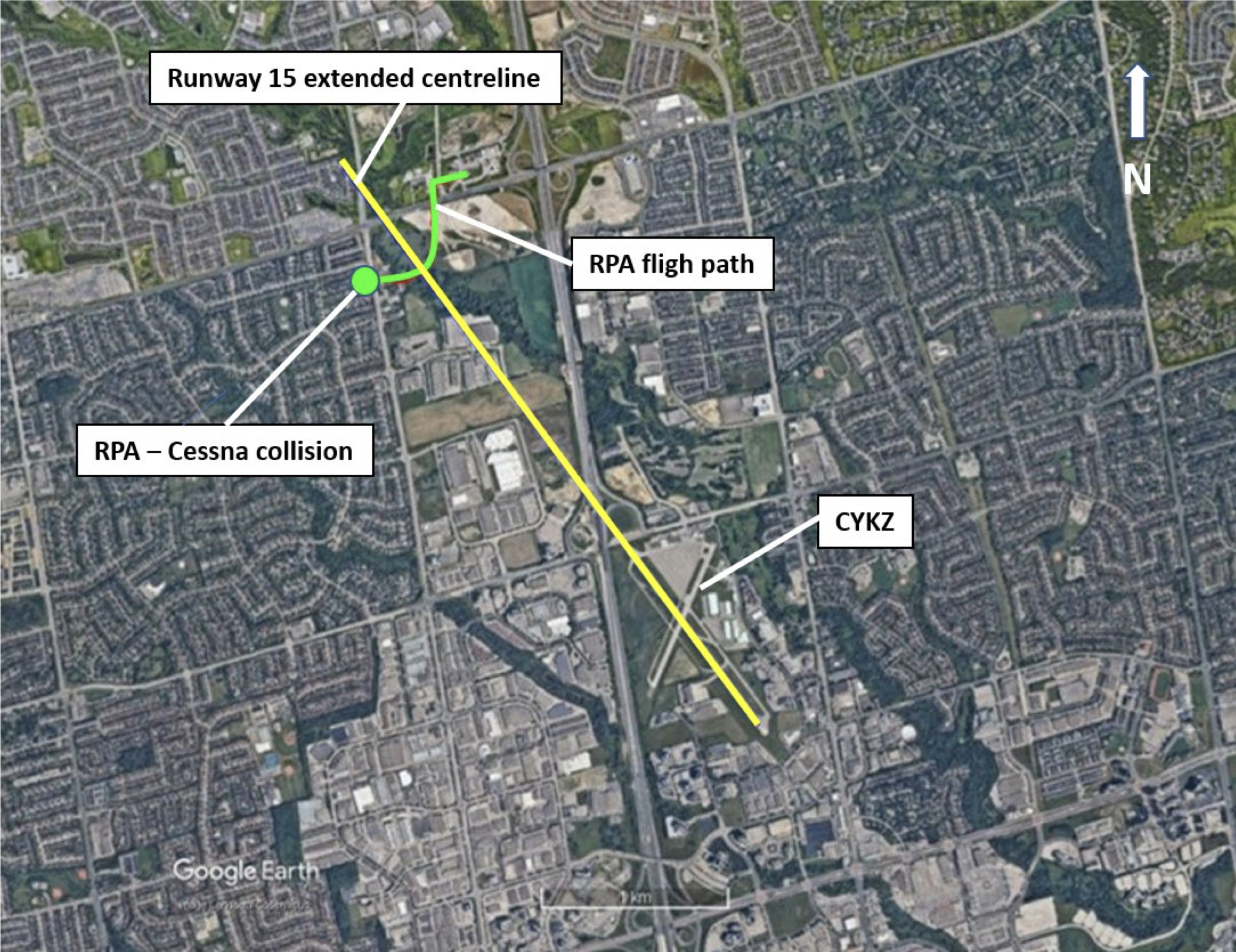
Here’s a look at the runway, along with the location of the RPAS. (Looks like the report missed a “t” on the word “flight.”)


Police Drone Collision

The drone


York Regional Police (YRP) were looking for a potentially armed suspect, and called the YRP’s Air Support Unit (ASU) to assist at 12:02 pm. The pilot of the drone arrived at the scene at 12:20. The first flight of the DJI Matrice M210 took off at 12:32. Shortly after takeoff, the pilot asked some officers standing nearby to watch the drone during flight; one of the officers said they’d do the task.

After some initial reconaissance, the officer landed the flight 16 minutes later to change batteries. It was now 12:48.

“During this time,” says the report, “the pilots in the Cessna had completed their exercises in the practice area and were returning to the airport. They made the appropriate radio calls declaring their intention to fly over the airport and join the right-hand downwind for Runway 15. There was no other traffic broadcasting on the CYKZ mandatory frequency (MF) at the time, nor had the pilots heard any other transmissions on the frequency during their return flight.”

It’s worth noting the “Mandatory Frequency” here. This airport does not have a tower and its own Air Traffic Control. Aircraft are to announce their intentions over a mandatory frequency (124.8 MHz) and monitor that same frequency for situational awareness of other air traffic.

At 12:56, the DJI M210 took off for its second flight. The pilot, who was watching a flat-screen tv displaying the drone feed, took the drone up to 400′ AGL.

The pilots in the Cessna, meanwhile, were scanning for other aircraft as they began their approach toward the runway. They made a radio call with their intentions to land at 12:57. When the drone reached 400′, it was put into a stationary hover.

But that hover, unfortunately, was directly in the flight path of the Cessna. The report notes that a stationary black object, when viewed against urban clutter, would likely not have stood out to the pilots. When the aircraft was approximately 1.2 nautical miles from the airport, traveling at about 65 knots (120 km/hour), it impacted the drone at 13:01.

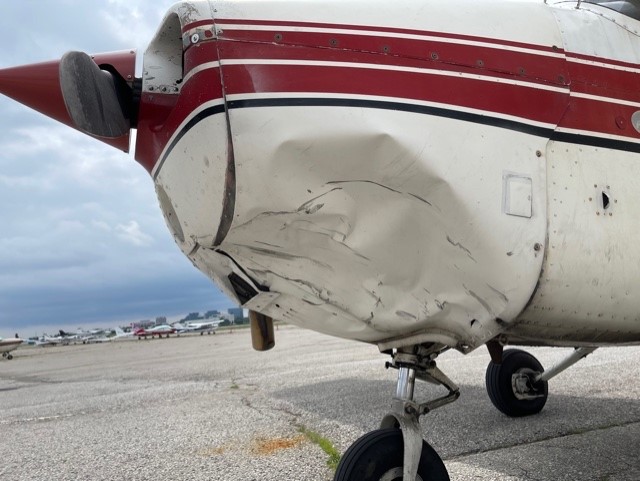
The Cessna landed without incident. But upon exiting the aircraft, this damage to the cowling was observed. There was also a slight scratch on the propeller.

Police Drone Collision

And the drone?

 Well, it was pretty much destroyed – as shown in this Transportation Safety Board photograph of the pieces that were recovered:

Police Drone

Other factors


The DJI drone was equipped with an Automatic Dependent Surveillance-Broadcast (ADS-B) receiver. These pick up signals from ADS-B equipped aircraft in the vicinity, and issue a warning to the drone pilot. The Cessna was not equipped with an ADS-B unit, however, so no warning would have been generated.

The Report says the drone pilot was monitoring the airport’s Mandatory Frequency during operations, using a handheld VHF radio. The drone pilot also had his Restricted Operator Certificate with Aeronautical Qualification (ROC-A), allowing him to operate an aviation radio. Unlike the pilots in the Cessna, drone operators are not required to broadcast their intentions when in controlled airspace. In fact, NAV CANADA does not encourage RPA pilots to broadcast on those radios, as it can contribute to clutter on the airwaves.

But the report does point out an additional key responsibility for Remotely Piloted Aircraft operators:

RPA operators are required to receive authorization from the provider of air traffic services (ATS) to operate in controlled airspace (see section 1.17.2.1). The request for this authorization must include contact information for the pilot, and “the means by which two-way communications with the appropriate air traffic control unit will be maintained.”

When authorization is granted from ATS, a telephone number for the relevant ATC unit is included in the authorization. This telephone number is to be used in case of an emergency or loss of control of the RPA. This exchange of contact information between RPA pilot and ATS is meant to satisfy the Canadian Aviation Regulations (CARS) requirement that two-way communication be maintained.

Flying a drone in controlled airspace requires obtaining clearance through NAV CANADA’s NAV Drone app. If the operation looks very complex and might involve greater than normal risk, the app will bump that request for a more careful review by Air Traffic Services.

But that’s not what happened. According to the Report, the NAV Drone app was not used at all in this incident.

The pilot of the occurrence RPA was aware of the NAV Drone application and knew that the operation on the day of the occurrence would take place entirely within the CYKZ control zone, therefore requiring authorization from ATS.

Due to the nature of the police operation underway, which involved a potentially armed individual, the RPA pilot felt a sense of urgency to get the RPA airborne as soon as possible. As well, the RPA pilot had not observed any traffic in the area during the set up of the RPA and had heard no recent transmissions on the hand-held VHF radio. As a result, the RPA pilot did not request authorization.

Interestingly, investigators later tested the NAV Drone app, requesting to fly an RPA at 400′ AGL at the location where the collision had occurred. The request was denied, and the app suggested they re-submit the request with a maximum altitude of 100′ AGL – a position far less likely to have caused problems for crewed aircraft on approach.

Police Drone Collision

Role of visual observer


The TSB Report spends some time on this topic. It also documents what happened on that day in October. It appears that the role of visual observer was not explained to the officer that took on the role. And it also appears that officer spent most of his time looking at the video feed from the drone, rather than maintaining Visual Line of Sight with the drone itself:

During the day of the occurrence, the RPA pilot asked for another officer to be a visual observer. Although a nearby officer acknowledged the request, the RPA pilot did not confirm who, among the officers present, would assume that role, nor did he inform that specific officer what their duties or responsibilities would be. The officer was not aware of the requirement to maintain visual contact with the RPA.

The officer who was acting as the visual observer was observing the TV display for much of the time that the RPA was airborne and did not see or hear any airborne traffic, nor could he recall hearing any radio calls over the RPA pilot’s portable VHF radio.

The report also notes that the drone pilot did not use the York Regional Police’s mandatory RPAS Pilot Checklist, and instead relied on memory to prepare for the flight. It further suggests the pilot may have been ‘task saturated,’ – “restricting his ability to visually monitor the RPA and hear radio calls on the control zone’s MF and the sound of incoming aircraft, both of which preceded the collision.”


Some findings…


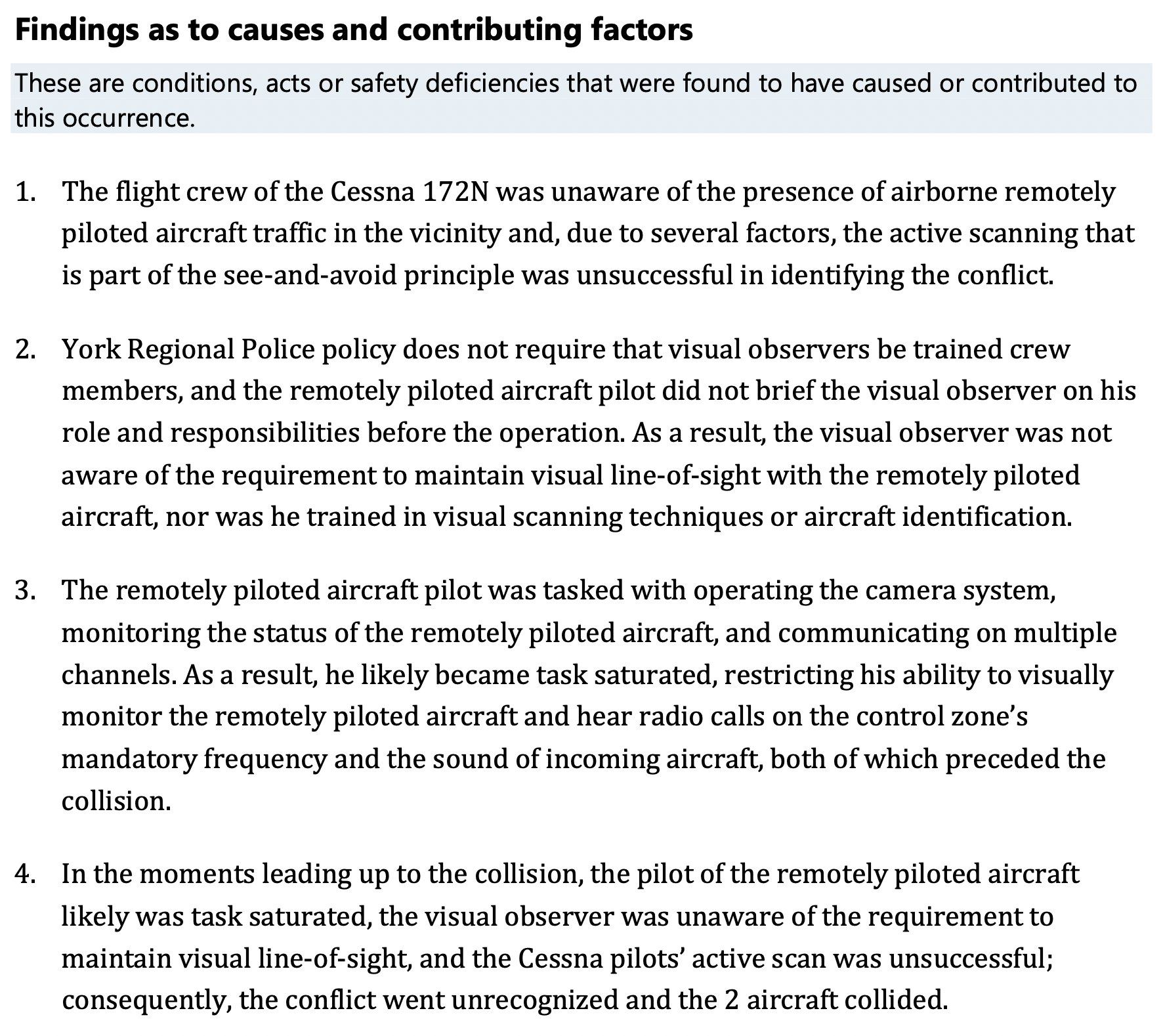
It is not the Transportation Safety Board’s role to find fault or blame. But it does identify contributing factors and/or causes that likely all played a role in the collision. Here are the four key findings on that count:

Police Drone Collision

“Findings as to risk”


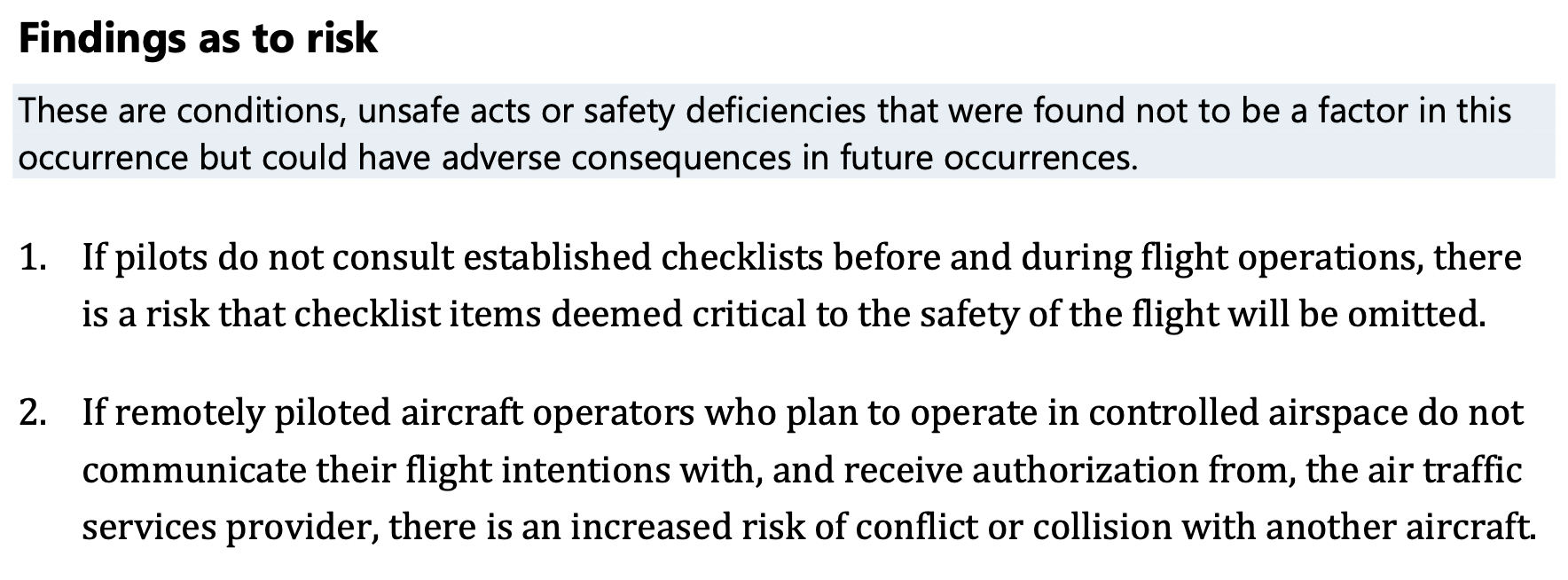
The report also notes two findings under the above category. It emphasizes that what appears below does not appear to have contributed to the collision, but could lead to adverse outcomes in the future:

Police Drone Collision

Kate Klassen weighs in…


InDro’s Kate Klassen is a drone and airplane pilot and has about 1000 hours instructing on the same type of plane involved in the collision. She’s also very familiar with the minutiae of RPAS regulations in Canada.

Klassen read this report with great interest and noted a few useful takeaways. In particular, how it appears the apparent focus on the task – catching a criminal suspect – may have obscured what should have been standard procedures.

“Typically First Responders have established with the Air Traffic Service providers that they can do the job and inform as soon as possible, rather than following the NAV Drone pre-authorization process the rest of us follow.” she says.

“So I think it’s less that they launched as they did, and more that they didn’t have the situational awareness to operate there safely. They were perhaps too invested in getting the job done, where they figured ‘It’s not going to happen to me’, and weren’t taking advantage of all the tools at their disposal. They probably didn’t realize how risky this location was, especially to be operating at that altitude.”


Briefing visual observer


Klassen also notes that the selection of a visual observer was not accompanied by any sort of thorough briefing – which would have included maintaining Visual Line of Sight with the RPA, monitoring the radio, and listening (along with watching) for any crewed aircraft.

“I think the situational awareness piece is important,” she says. “Have the radio on the right frequency, have the visual observer actively monitoring it. It can’t be just ticking the box that you’ve assigned someone the task.”

“A more effective trained role would be explaining or ensuring they have skill to listen in on the radio and build that situational awareness of where the aircraft are. Also monitoring the sky, listening for aircraft noise. If you can hear a crewed aircraft but not see it, that’s when it’s sketchy.”

Klassen has worked with many First Responders across Canada, and understands the pressure they can be under to get a drone in the air. The challenge is to follow Standard Operating Procedures despite that pressure – particularly in controlled airspace this close to an airport.


InDro’s take


Though no one was injured during this collision, it was a serious incident. The drone could just as easily have hit the windshield, the leading edge of the wings near the fuel tanks or damaged the landing gear. Thankfully, that didn’t happen.

The Transportation Safety Board report is both methodical and meticulous. While not pointing the finger of blame, it does highlight some procedures that most certainly could have been handled better – and likely would have, were the flight not so high-priority.

Accidents and investigations should be, in our view, viewed as learning opportunities. And in this case – whether you’re a First Responder or not – there are clearly lessons to be learned.

Breaking drone regulations can be expensive

Breaking drone regulations can be expensive

By Scott Simmie


Drone regulations exist for a reason. Actually, multiple reasons.

Probably the most important is to keep airspace safe and avoid any potential collisions or interference with crewed aircraft. That’s why altitude is limited to 400′ above ground level (AGL), and why flights in controlled airspace must be cleared through NAV Canada’s NAV Drone app. (If you’re a drone pilot and don’t have this app, you can get more details and links to download here.)

And, just as a reminder on that front, drones carrying out basic operations must be at least 5.6 kilometres (three nautical miles) from airports and 1.9 kilometres (one nautical mile) from heliports.

One of the other key reasons is to protect people and property on the ground. If you’re flying a drone weighing more than 250 grams and less than 25 kilograms, you’ll need to ensure that you’re separated horizontally from bystanders by at least 30 meters – though drones with an RPAS Safety Assurance declaration can fly closer in Advanced operations.

There are, of course, other rules. No flying over outdoor concerts, parades or other special events. Some of you may recall that a drone pilot paid a hefty price during the victory parade for the Toronto Raptors in 2019. The person in question flew over the event and was fined $2750 by Transport Canada. (We actually were at that parade and saw the pilot take off; he was flying a DJI Mavic Pro.)

Breaking drone rules can be expensive.

Below: A 360° shot taken during Raptors celebrations. The illegal drone flight took off about 15m from where this image was taken.

Drone Regulations

There’s a reason behind every rule


The laws that govern drones in Canada are written up in a section of the Canadian Aviation Regulations, also known as CARs. Specifically, they reside in Part IX. We recommend that everyone flying a drone in Canada – particularly drones weighing more than 250 grams – has a read through this section. It lays out the rules very clearly.

And if you break those rules? Well, there’s a price to pay. Fines for individuals include:

  • up to $1,000 for flying without a drone pilot certificate
  • up to $1,000 for flying unregistered or unmarked drones
  • up to $1,000 for flying where you are not allowed
  • up to $3,000 for putting aircraft and people at risk

So it’s worth knowing the regs, because violating them can both create risk and be very costly.


Forest fires


Wildfires in Canadian forests cause major problems every year. Significant resources are allocated to try to control and extinguish these fires – which often occur in remote locations. Aerial firefighting techniques are a big part of the equation, with water bombers and helicopters routinely deployed. (You can get a snapshot of the current wildfire situation in Canada with this interactive map. At the time this article was written, a significant Alberta fire – north of Banff and east of Lake Louise – was out of control. That fire started August 31 and has been burning for three and a half months.)

Helicopters are used to transport crews, and occasionally drop fuel retardant on small hotspots. Water bombers come in low to take on water from lakes and also drop that same water on fires from low altitudes so that targeting is accurate and there’s minimal dispersal of the fluid on the way to the ground.

And both of those scenarios? They mean these aircraft are often flying below 400′ AGL.

Drone regulations

Keep your drone clear of forest fire operations


With that context, you no doubt have guessed where we’re going with this. Rules in CARs Part IX prohibit flying drones near forest fire operations. In fact, you must keep drones (and other aircraft not involved with the operations) at least five nautical miles (9.3 kilometres) away from the scene. There is also a mechanism within the Canada National Parks Act that allows for the prohibition of activities – including the banning of drone flights.

Recently, a drone pilot found out just how seriously regulators take flying drones close to a wildfire. A Canadian Press story published December 9th says that Rajwinder Singh was found guilty in an Alberta provincial court of the offence and fined $10,000.

In fact, Singh was one of four people charged for flying too close to the Chetamon wildfire in September. Four drones were also seized by authories.


InDro’s role


InDro Robotics played a role on the technology side. The company supplied drone detection equipment capable of identifying models, location and trajectory of drones in proximity of Alberta wildfires.

InDro is also involved with the Ottawa International Airport Authority’s ongoing Drone Detection Pilot Project at the Ottawa International Airport. Early in 2021, during the convoy blockade that took place in Ottawa, that project detected a very high number of illegal drone flights taking place over sensitive areas in the capital’s downtown core.

In fact, a sister company of InDro Robotics – Bravo Zulu Secure – specializes in drone detection and mitigation systems. InDro Founder and CEO Philip Reece is the Chief Technical Officer of Bravo Zulu. Here, he explains some of the company’s proprietary systems:

InDro’s Take


We’ve been in this business long enough to remember the early days. The drone space was often called The Wild West, because many people were either unaware of regulations or chose to willfully ignore them. This was particularly true of rogue pilots, usually recreational operators, who would carry out reckless flights. Those flights often (and rightfully) received negative press coverage and caused regulators to take an even more cautious, incremental approach with opening up the skies. Understandable.

Since then, the drone community has done a great job of educating and even policing itself. Flights like the four that took place near that Alberta wildfire are now, fortunately, very rare.

But, as we’ve seen here, they still happen. Not only is it wise for drone operators to become fully familiar with Part IX of CARs, but also to be aware that hefty fines can and will be imposed on those who violate the law. It’s also worth remembering, regardless of location, that the technology exists to detect these flights, along with the location of the operator.

Thankfully, the vast majority of drone pilots know the regulations – and abide by them.

Spexi announces “Spexigon” – a global fly-to-earn platform

Spexi announces “Spexigon” – a global fly-to-earn platform

Vancouver-based Spexi Geospatial has some news – and it’s big.

The company has announced a plan, and a platform, to capture high-resolution aerial data of the earth with drones. Drone pilots will be able to fly to earn crypto currency – or even dollars.

The long-term goal? Well, picture crystal-clear data sets of cities, infrastructure, and even rural settings. With each individual pilot capturing data from different locations, Spexigon will assemble it over time to form a global jigsaw puzzle – and sell parts of that dataset to clients.

We’ll get into more details shortly, but Spexi’s plan has some strong backers – including InDro Robotics.


News release


News of Spexigon came in the form of an announcement. The company revealed it had secured $5.5 million USD in seed funding “to pursue our vision of collecting Earth’s most important data with drones.” The funding round was led by Blockchange Ventures, with other investing by InDro Robotics, Protocol Labs, Alliance DAO, FJ Labs, Dapper Labs, Vinny Lingham, Adam Jackson, and CyLon Ventures.

The same team that built Spexi – an easy-to use system for automated flight and data acquisition – is developing Spexigon. This brief video gives a “big picture” look at how it will work when it’s rolled out next year.

“Fly to earn”


A big part of what makes Spexigon’s plan so intriguing is what you might call incentivised crowd-sourcing. Anyone with a drone can download the forthcoming Spexigon app and fly an automated flight. The images will be uploaded to Spexigon to build the database – and the pilot will be rewarded.

“With our new Fly-to-Earn model, people who own consumer drones will be able to earn $SPEXI tokens and dollars while building a high resolution base layer of the earth,” reads the Spexigon announcement. “It is our hope that soon any organization or individual will be able to use the imagery collected by the Spexigon platform to make better decisions.”


Business model


You could think of this over time as like Google Earth, only with really sharp aerial imagery. Every time a pilot carries out a flight for Spexigon, that map will continue to fill in, building Spexigon’s database. Clients will purchase imagery online.

“This new base layer will enable governments and organizations of all sizes to make better decisions about real world assets like buildings, utilities, infrastructure, risk and natural resources, without requiring people on the ground,” continues the announcement.

“By using Spexigon, organizations that require high-resolution aerial imagery will no longer need to own their own drones or hire their own pilots. Instead, they’ll use our web and mobile app to search for and purchase imagery. Data buyers will then be able to use a variety of internal and external tools to put the imagery to use.”


For pilots


Spexigon says it will have online training when it launches. Pilots will learn how to use the app to carry out their flights – which, obviously, the pilots will monitor. Depending on the location, pilots can earn crypto currency or actual dollars. Some locations, obviously, will have greater value to Spexigon and its clients than others.

“The app will contain a map of the earth overlaid with hexagonal zones called ‘Spexigons’. Spexigons that are open and ready to fly will be easily visible so pilots can choose an area close to them and begin collecting imagery,” says the company.

“To ensure that imagery is captured in a safe, standardized, and repeatable way, our app controls each pilot’s drone automatically while they supervise the flight. Although our app will do the flying, pilots will always be in command and will have the ability to take back manual control at any time if need arises.”

Spexigon is now starting to build the app, and already has a small community emerging. You can join its Telegram channel here – and there’s also a Discord channel.

As for those ‘Spexigons’, the image below gives you an idea what those pieces of the puzzle might look like.

Spexi

InDro’s take


Since InDro Robotics is one of the backers of Spexigon, we obviously feel the plan is a good one.

It comes from the outstanding team that built Spexi from scratch into a user-friendly, automated system for capturing and crunching aerial data. We also believe drone pilots will embrace this unique “fly to earn” model – a global first.

“The Spexi team has already created an excellent and proven Software as a Solution product and clearly has the expertise in this space,” says InDro Robotics CEO Philip Reece. “I’m genuinely excited about the potential for Spexigon to become the ‘go-to’ database of high-quality aerial imagery from around the world.”

So are the rest of us.

Methane detection via drone with Aerometrix

Methane detection via drone with Aerometrix

By Scott Simmie


There’s no denying climate change. Whether it’s the recent and devastating floods in Pakistan, fires in Portugal – or the multiple rivers globally that have dropped to historically low levels – the planet’s equilibrium has been changing.

While carbon dioxide emissions get much of the press, methane is one of the most potent contributors to the problem of greenhouse gases.

“Methane has more than 80 times the warming power of carbon dioxide over the first 20 years after it reaches the atmosphere,” states the Environmental Defense Fund.

“Even though CO2 has a longer-lasting effect, methane sets the pace for warming in the near term.”

That’s a key reason why the detection of methane emissions has become a priority. It’s also a large part of why Aerometrix – a company specialising in methane detection using drones – was formed.

Below: One of the early Aerometrix rigs for methane detection. The sensor is at the forward end of the counter-weighted rod to keep it clear of prop wash.

Aerometrix

Aerometrix


Before we get more into what Aerometrix does (and how it does it), we should point out there’s an InDro Robotics connection here. InDro CEO Philip Reece, along with Michael Whiticar, founded the company. Aerial operations for Aerometrix are carried out by InDro Robotics.

“We felt there was a void in the marketplace for the detection of methane and other gases,” explains Reece. “We also wanted to approach this from an engineering-first perspective, ensuring that we were using, and even developing, the best available sensors and workflow.”

Aerometrix uses two different types of sensors for methane detection. The first is the proprietary GasMap sensor, which is capable of detecting methane in parts per billion (ppb). This laser-based sensor had its origins at NASA’s Jet Propulsion Laboratory, where it was developed for Mars missions. Aerometrix has further refined that sensor and has used it to accurately map methane emissions at petrochemical plants, gas wells, landfills – and even on agricultural sites. (Animals, particularly cows, are a significant methane source.)

“GasMap uses laser spectroscopy,” explains Peter Sherk, an electronics engineer with Aerometrix. “It uses the absorption of lasers by methane to detect concentration. And it’s very precise – detecting not only its presence, but how much there is at a given point in time and space right down to parts per billion.”

The sensor maps methane (and other gases) by flying horizontally through the plume. When multiple passes at different altitudes have been completed, a “curtain” is obtained. (Don’t worry, we won’t ask you to carry out the calculation – besides, our FluxCurtain software does that.)

Flux Curtain

Zig-zag


As mentioned, the drone flies horizontally through the plume – with each parallel flight at a slightly higher altitude. The sensor is constantly capturing georeferenced data which Aerometrix then runs through software.

In the images below, you’ll see that zig-zag flight pattern. The blue lines at the bottom indicate methane concentrations. Not surprisingly, those concentrations begin to dissipate at higher altitudes as the methane plume mixes with the surrounding air.

The second image is what’s referred to as the actual “Flux Plane” – where the methane concentrations are represented visually by colour.

Methane Detection
Methane Detection

Efficiency


Though pipelines and facilities that handle methane are obvious places where detection is required, local city dumps are also interested in detecting – and even capturing – methane produced by buried garbage. But many are unaware of the efficiency and accuracy of using sensors like the GasMap mounted on a drone.

“A lot of landfills are doing methane detection already,” says Sherk, “but they’re using far less convenient methods. A lot of the time there’s someone walking back and forth with handheld sensors. With larger landfills any sort of grid pattern will take days and days – and walking over an old landfill can’t be a really healthy operation.Operating a drone is vastly more efficient. And the GasMap sensor is capable of detecting not only the presence of methane, but its concentration at various altitudes as the gas forms a plume and mixes with surrounding air.

Some landfills have been able to not only capture but exploit methane that was previously escaping. The Capital Regional District on southern Vancouver Island has been running a power generating plant on-site at the Hartland Landfill, fuelled solely by captured methane produced by decomposing garbage. It’s been doing so since 2004, creating enough energy to power 1,600 homes.

Recently, the volume of methane produced by the landfill has increased, and the power plant is nearing the end of its operational life. In 2023, the landfill will switch gears and process the biogas into natural gas – selling the product to FORTIS BC.

Kudos to the Capital Region District for having such foresight; the example also highlights how captured methane can be put to positive use.

Aerometrix has carried out surveys now at numerous landfills hoping to capture or otherwise mitigate methane emissions. Using FluxCurtain software, its reports turn what was previously an invisible problem into clear, actionable data that provide a clear picture of emissions and concentrations.

Methane Detection

Another sensor


We mentioned a second sensor also being used by Aerometrix. It’s called the LaserScan, and it’s a very lightweight sensor that also uses laser spectroscopy to detect the presence of methane.

Unlike the GasMap, the newer sensor is able to measure vertically. In other words, the drone can be flying directly above a plume and take a measurement straight down to the ground. While it’s not quite as precise as the GasMap sensor (parts per million, rather than parts per billion), the LaserScan does have an advantage when it comes to speed.

Because it does not rely on flying through the plume, the LaserScan is ideal for detecting emissions over large areas. By simply flying a grid pattern at a single altitude, it can rapidly identify emissions. At an altitude of 98.4′, it’s capable of detecting 500 ppm of methane with a plume diameter of one meter.

“While the Falcon is less precise than the GasMap sensor, it has a definite advantage when it comes to speed,” explains Keegan Richter, a mechanical engineer with Aerometrix.

In cases where greater precision is required, Aerometrix can fly two missions: The first with the LaserScan to rapidly detect the location of emissions – particularly over large landfills – followed by GasMap for parts-per-billion accuracy.

Methane Detection

InDro’s Take


We obviously have a special interest in Aerometrix, since InDro’s pilots and drones carry out its aerial missions.

Not surprisingly, since CEO Philip Reece is a co-founder, the mission of Aerometrix closely aligns with InDro’s guiding philosophy: Developing and utilising technology to increase efficiency and – whenever possible – contribute to positive change.

Arguably, the dramatic and apparently escalating shifts we’ve seen to global climate patterns are one of the most pressing problems on the planet. Methane is a key contributor to those changes.

The ability of Aerometrix to accurately detect methane emissions has already helped clients cap leaks and examine other methods for capturing this gas before it hits the atmosphere. Its missions have also meant that human beings are no longer exposed to hazardous environments while capturing data using handheld devices.

In our mind, those are both positive outcomes.

Interested in more information? You can contact Aerometrix directly here.

Volkswagen reveals passenger-carrying eVTOL

Volkswagen reveals passenger-carrying eVTOL

Volkswagen is entering the Urban Air Mobility world.

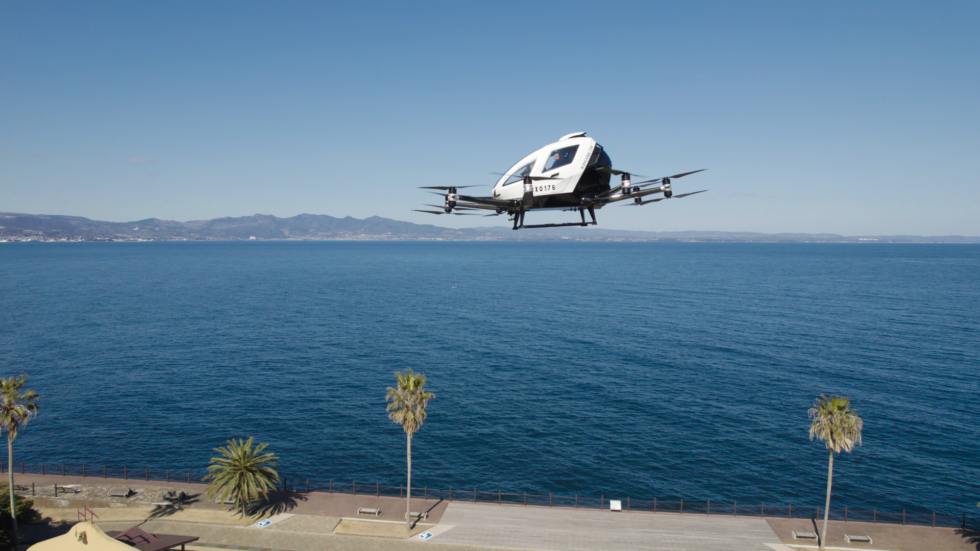
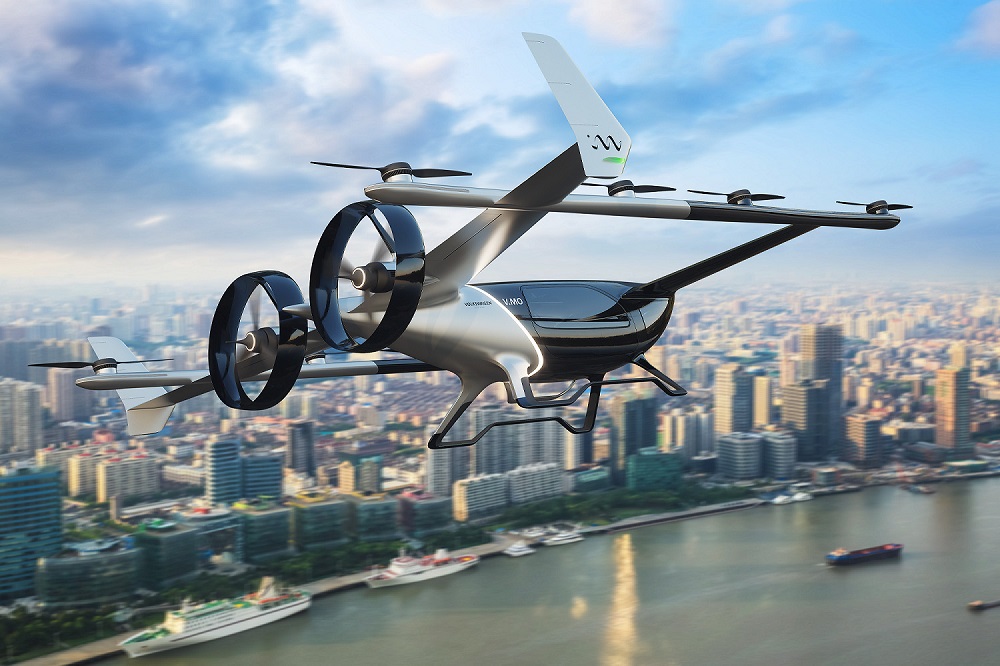
The company’s China division has unveiled it has been working on a passenger-carrying e-VTOL – and says it plans to commercialise it down the road. The prototype is called V.MO and is part of Volkswagen China’s Vertical Mobility project.

“Through this pilot project, we are bringing Volkswagen’s long tradition of precision engineering, design, and innovation to the next level, by developing a premium product that will serve the vertical mobility needs of our future tech savvy Chinese customers,” said Dr. Stephan Wöllenstein, CEO of Volkswagen Group China.

“This is a pioneering project which our young team of Chinese experts started from scratch – they are working with new design concepts and materials while developing new safety standards, disrupting and innovating every step of the way. Our long-term aim is to industrialize this concept and, like a ‘Flying Tiger’, break new ground in this emerging and fast-evolving new mobility market.”

The ‘Flying Tiger’ nickname refers to the prototype’s gold and black livery – which you’ll see in the photo below. We’ve added a second image with people for scale.


Volkswagen eVTOL
Volkswagen eVTOL
As you can see, lift comes from eight motors, four on each of the twin booms. Forward thrust comes from two motors. Length of the prototype is 11.2m with a span of 10.6m, so you won’t be landing this in your driveway. Presumably, the commercial version will take off and land from something like a heliport, offering passengers the option to quickly cross a congested city or head to a nearby destination.

“In its final future iteration, the fully electric and automated eVTOL could eventually carry four passengers plus luggage over a distance of up to 200km,” states a Volkswagen news release on the project.

This first prototype appears to be built for unmanned testing and validation. The company says several test flights of V.MO will take place later this year, with plans for an improved prototype to be flying in the summer of 2023.

And what might it look like? Well, probably something like this animation:

Though Volkswagen has plenty of engineering expertise on the ground, making something that flies isn’t really in its wheelhouse. That’s why the company has partnered with Hunan Sunward Technology, a manufacturer of light aircraft and drones.

The press release announcing the prototype made it clear that Volkswagen sees vast potential in Urban Air Mobility and products like these.

“Urban air mobility is a fast-emerging market which aims to utilize air space for short- and medium-distance connections, especially above and between large cities,” it states. “In China, it is set to play a significant role in the future of urban and intercity transportation in its congested megacities. In the first phase of its commercial use, V.MO is likely to be pitched as a premium product for high-net worth tech savvy Chinese customers, for example for VIP air shuttle services. eVTOL air vehicles will be able to transport passengers more quickly and efficiently than current conventional means of terrestrial transport and with greater flexibility. As the Vertical Mobility project develops, Volkswagen Group China will work with the relevant Chinese authorities to achieve certification.”

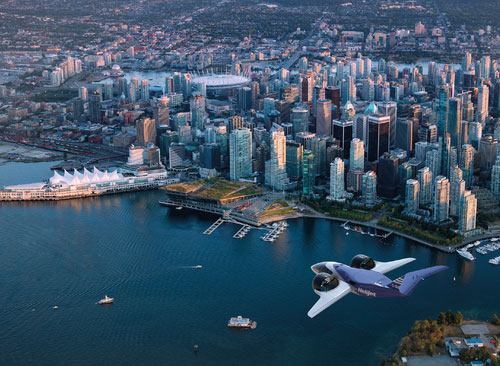
With the announcement, Volkswagen becomes the latest automotive player to stake a claim in this sector. Honda, Toyota, Aston Martin and others have announced they’re entering the space and have displayed concepts, prototypes or renders of their plans. Hyundai unveiled this Uber Air taxi concept a couple of years back:

Still some hurdles


Will we be seeing these vehicles – in real life – in the years to come?

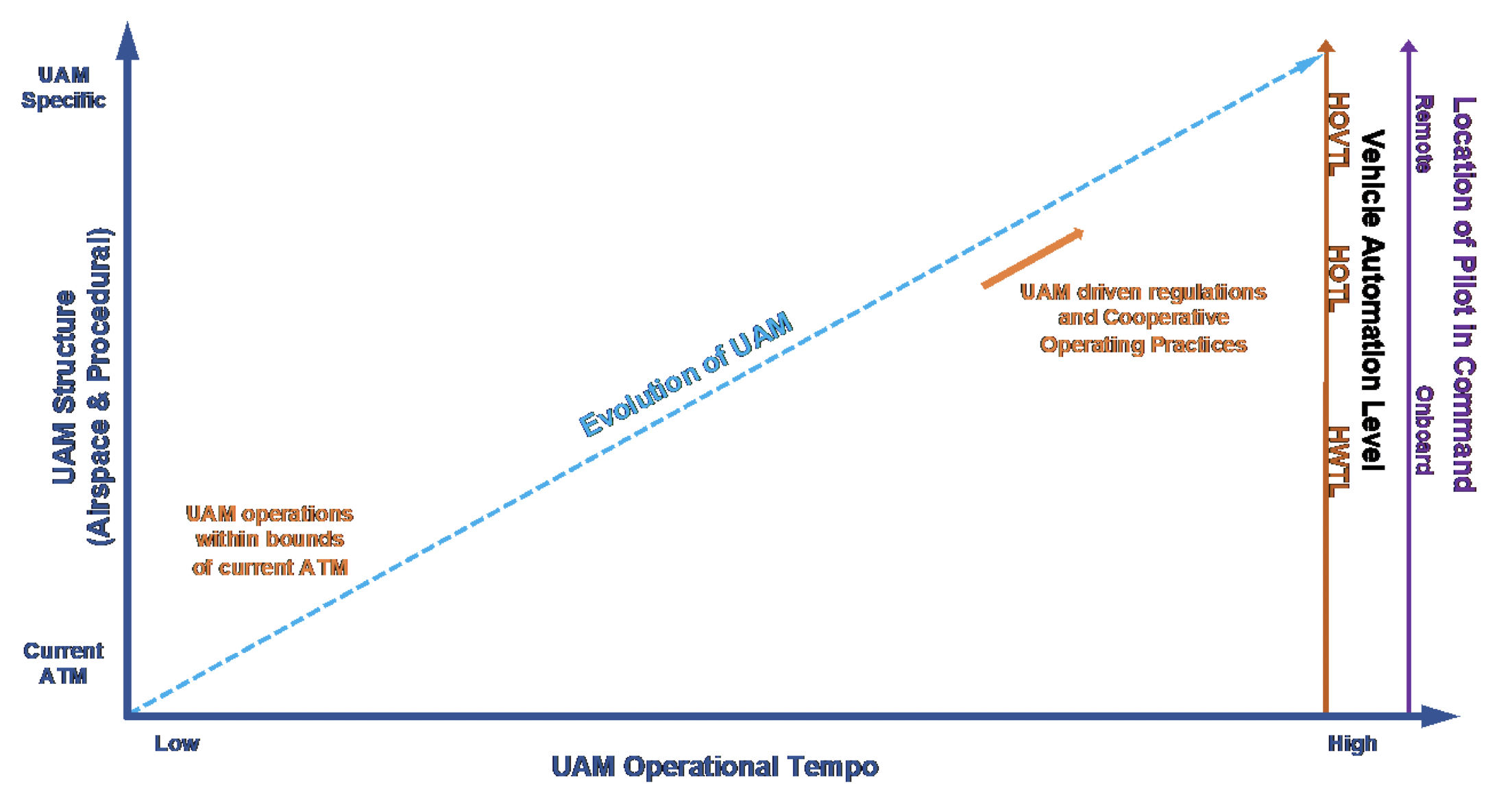
The answer is yes, but there are still challenges that must be overcome. Urban Air Mobility envisions a future where eVTOLs will transit congested urban centres, whisking passengers who will likely summon these aircraft using mobile apps to nearby take-off and landing sites. UAM will also bring the option of convenient flight traffic between nearby cities where one or both do not have the infrastructure or demand to support traditional fixed-wing aircraft. Plus, the ability to deliver people or goods to central locations in a large city offers a convenience that eludes most traditional airports.

But getting there will take some time. These eVTOLs will face rigid certification, and require a robust Unmanned Traffic Management (UTM) system/network to ensure there’s no conflict with drones or other forms of aviation. Work on those fronts is underway. In fact, the White House even held a special summit on the topic August 3. The goal of that gathering was to explore “the future of aviation in America and the regulatory strategy towards responsible and equitable adoption of these technologies.”

It’s clearly firmly on the radar of regulators.

Multiple designs, including single-person eVTOLs


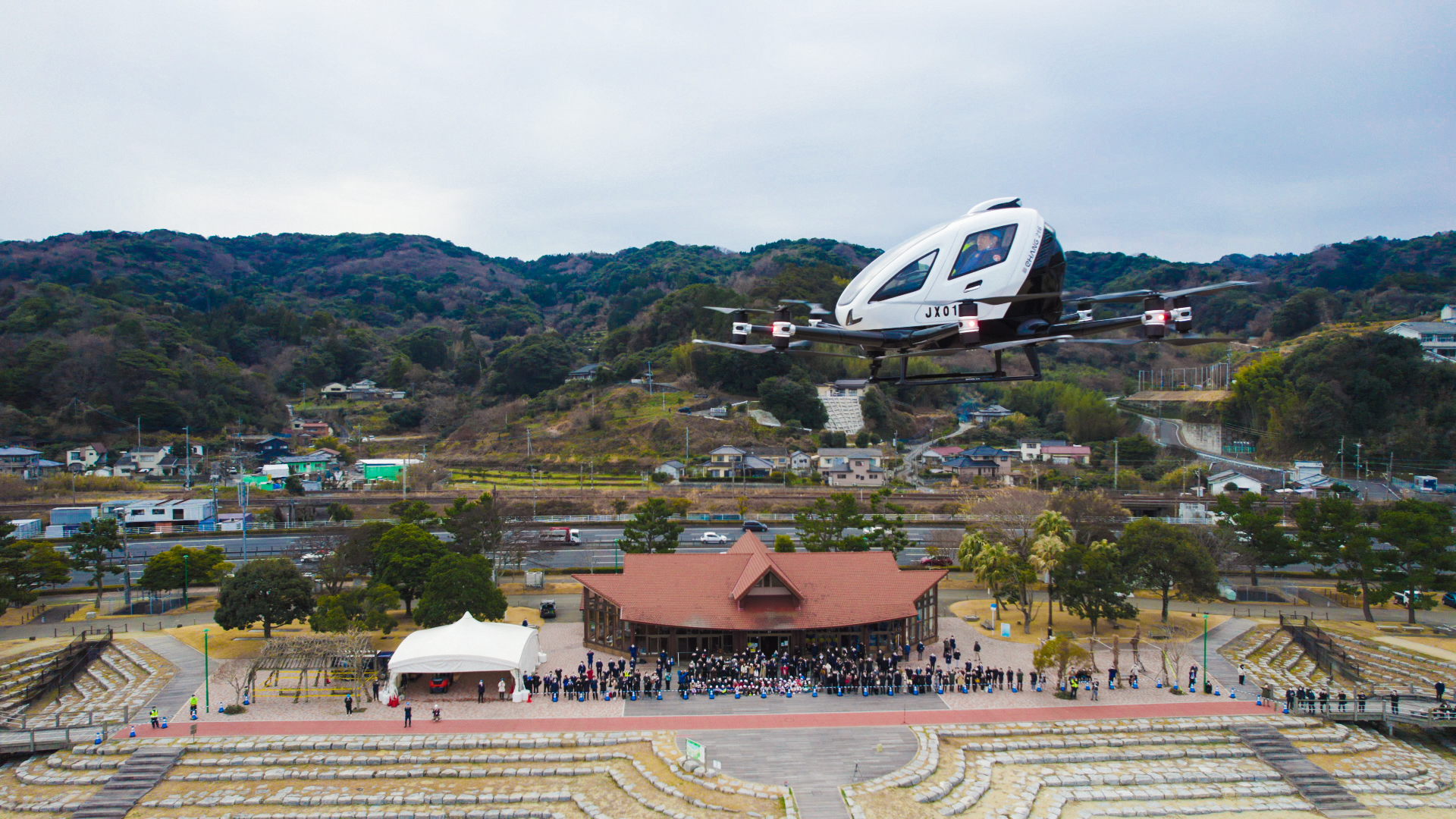
There are many different companies vying for a piece of this territory. Perhaps the one with the greatest advantage is China’s eHang, which produces one- and two-passenger autonomous vehicles that have carried out a growing number of autonomous flights carrying people. The company is also apparently at work on a two-passenger, fixed-wing eVTOL for longer-range flights.

The company has already carried out autonomous tourism flights and appears to have a spotless safety record.

Personal eVTOLs


In the Urban Air Mobility world, there are greater efficiencies with aircraft capable of carrying multiple passengers (or heavier cargo loads). But some manufacturers are targeting the single-occupant market. Specifically, they’re building products for people who would like to not only pilot these aircraft, but own them.

The leader on this front appears to be Swedish company Jetson, which manufactures a single-person eVTOL that is flown by the pilot. The Jetson One costs $92,000 US and is in production. It’s unclear how many the company will produce annually, but it has received enough orders that Jetson is completely sold out for 2022 and now taking orders to be shipped in 2023.

We can’t resist dropping in another video, because this actually does look like fun.


And finally…a Canadian connection


We’d be remiss if we didn’t point out another very unique company in this space. It’s called Opener, and its vehicle is the BlackFly. It’s a very intriguing design that was the brainchild of a retired Canadian engineer with a fancy for flight. That engineer is Marcus Leng.

He first developed the concept for the amphibious vehicle (yes, it can land on and take-off from water) in 2009. In 2011, he flew the first proof-of-concept prototype from his front yard in Warkworth, Ontario.

Since then? Well, the company has carried out more than 4,300 flights, covering more than 56,000 kilometres. It has flown manned demo flights at the big airshow in Oshkosh, and is about to release the product for sale.

The cost? There’s not a definitive figure yet, but the company promises it will be about the cost of an SUV. It qualifies in the ultralight category, meaning owners won’t require a private pilot’s license.

And yes, we’re pretty intrigued by this. Kudos, Marcus Leng. Oh – and this video? It’s from back in 2018, so we can only imagine what refinements have been made since then.

InDro’s Take


As we know from our extensive work in the aerial and ground robotics worlds, technology continues to rapidly advance. That translates into better components, flight controllers, battery efficiency, simulations – and, ultimately, reliability and safety.

There is still a ways to go, as mentioned, on the certification and UTM front for many of the multi-passenger vehicles under development. But we do see such aircraft taking hold in the future – offering new and more sustainable options for the delivery of goods and people over short distances.

If you’re interested in this field, we highly recommend you check out the Canadian Advanced Air Mobility Consortium. The organization already has some 70 members (including InDro Robotics) who are working collaboratively to help shape the future and work with regulators. Advanced Air Mobility/Urban Air Mobility promises a future of exciting possibilities that will benefit both passengers and communities, particularly since many of these aircraft can be used to deliver critical goods and supplies on-demand and autonomously.

It’s a future we look forward to – and it’s definitely on the horizon.

Spexi offers broad range of geospatial tools for drone pilots

Spexi offers broad range of geospatial tools for drone pilots

A Canadian firm has been quietly gaining customers – and a reputation – with its broad palette of geospatial tools for drone operations.

That company is Vancouver-based Spexi.

And while it might not be a household name yet, a growing number of professional drone operators are using its palette of tools (including its mobile app), to plan efficient and accurate flights for the gathering of geospatial data.

The Spexi platform has been designed for a wide variety of sectors requiring actionable data from above, including real estate, construction, precision agriculture and more.

On the real estate front, here’s an example of a panorama produced with Spexi. Get in there with your mouse and scroll around. You can also zoom via scroll or pinching on your trackpad.

The big picture


That panorama was seamless, and with great resolution even zoomed in. But it’s only one of many offerings on the Spexi platform. So let’s take a step back for a look at the bigger picture.

The Spexi website outlines the company’s many offerings, along with features of its powerful mobile app.

In terms of data products, Spexi offers the following:

  • 3D models and point clouds showing proportionality of the building and structural features
  • High resolution image galleries with annotations for easy collaboration
  • Up-to-date Google Map tiles showing the property with the ability to measure slopes & volumes and annotate features
  • High resolution image galleries with annotations for easy collaboration
  • 360˚ panoramas with hot spots for points of interest

Here’s a look at a volumetric calculation captured and computed via Spexi. Beats trying to do this manually:

Spexi

The Spexi app


A large part of the Spexi value proposition is its mobile app. It allows pilots to quickly plan flight parameters, carry out autonomous data capturing missions, upload and crunch the data – and share the resulting files with stakeholders.

Specific features of the app include:

  • Planning tools for efficient and accurate data acquisition
  • Autonomous flight using the latest DJI drones
  • Secure, cloud-based footage processing and sharing
  • Spexi can carry out survey work using Ground Control Points.

Not a pilot but need a job? Spexi offers access to its network of pilots who can take on the mission on your behalf.

Cost?


Good question. Spexi offers a couple of options here, suitable both for those requiring the odd one-off job as well as Enterprise users.

If you’re interested in only the occasional mission, Spexi offers both value and incentive via its “credit” option. Sign up for a free account and you’ll receive five credits. A single credit can be used for a job like the panorama you saw above. A single credit covers up to 100 uploaded images and processing. So just by signing up you can cover five jobs like this. Additional credits can be purchased for $15 each.

Users with high volume processing needs can sign up for the monthly plan. It allows for the processing of up to 3,000 images per month at a cost of $300 per month. If you’re an ultra heavy user, Spexi offers packages for requirements exceeding 3,000 monthly images.

“Our goal is really to help companies and people transform their operations to be more efficient using drones and make better decisions with drone-based data,” explains Spexi Chief Operating Officer Alec Wilson – a helicopter pilot with a degree in geography and remote sensing. He was also a key part of the team that built Coastal Drones into a large online learning platform.

“Spexi is really the only Canadian drone software-based platform that can service contracts at this scale,” he says.

Spexi has already received a vote of confidence from the federal government. Innovative Solutions Canada offered financial backing to Spexi on its path to commercialization and enabled testing and evaluation of the product, including some pretty ambitious missions. Here’s COO Wilson, in a video explaining just one of multiple projects it carried out as a result.

Just the beginning


Though Spexi is already an easy-to-use platform with mutiple use-cases, expect more features to come. With the promise of routine BVLOS flight hopefully somewhere around the corner, COO Alec Wilson has ambitious plans for the near future.

“Looking into the future, we see our platform being used to produce drone-based data at much larger scales,” he says.

“There are some amazing new emerging technologies that enable collaboration in ways we have never seen before.  We are in the infancy of this technology, and we at Spexi have some big plans to get drone-based data into the hands of those who need it most including leveraging BVLOS capabilities once available.”

Plans also include collaboration and integration with the FLYY training platform, enabling students to take a deep dive into Spexi’s capabilities. More on that soon.

InDro’s Take


We’re pleased to see a Canadian data acquisition and processing company begin to make its name in the field. While it’s up against some stiff competition from larger photogrammetry companies, the Spexi platform is simple to use and powerful – with plans for enhanced capabilities as the industry evolves. Its option for pay-as-you-go credits for those requiring one-off missions is attractive and a great way to test the waters (especially with five free credits on sign-up).

InDro Robotics has some collaboration underway with Spexi, and anticipates this relationship will only grow. More details on that…down the road.

CONTACT

INDRO ROBOTICS
305, 31 Bastion Square,
Victoria, BC, V8W 1J1

P: 1-844-GOINDRO
(1-844-464-6376)

E: Info@InDroRobotics.com

copyright 2022 © InDro Robotics all rights reserved