
Made-in-Canada Defence Solutions Must Accelerate: David McGuinty
By Scott Simmie
Canada’s Defence Industrial Strategy (DIS), revealed in February of 2026, wasn’t just another political announcement. It was a monumental, strategic shift in how Canada’s Department of National Defence (DND) will obtain the tools it needs.
“To protect Canada’s sovereignty, build our prosperity, and strengthen our strategic autonomy, the Canadian government must change how we invest in defence,” said Prime Minister Mark Carney on February 17.
One of the core tenets of the strategy is that Canada must foster and grow its own solutions to serve the broad needs of defence and sovereignty. Doing so, said Carney, will not only strengthen the country’s capabilities but also its economy.
“Canada is developing leadership in areas that will be increasingly central to defence, including space, artificial intelligence, cyber, quantum, medical countermeasures, robotics, and drones,” he said, emphasising the DIS will focus on developing and procuring Made-in-Canada solutions, or partnering with allies other than the United States.
“In this century, the work of defending Canada is the work of building Canada,” he said. “Its framework is simple: build, partner, buy.”
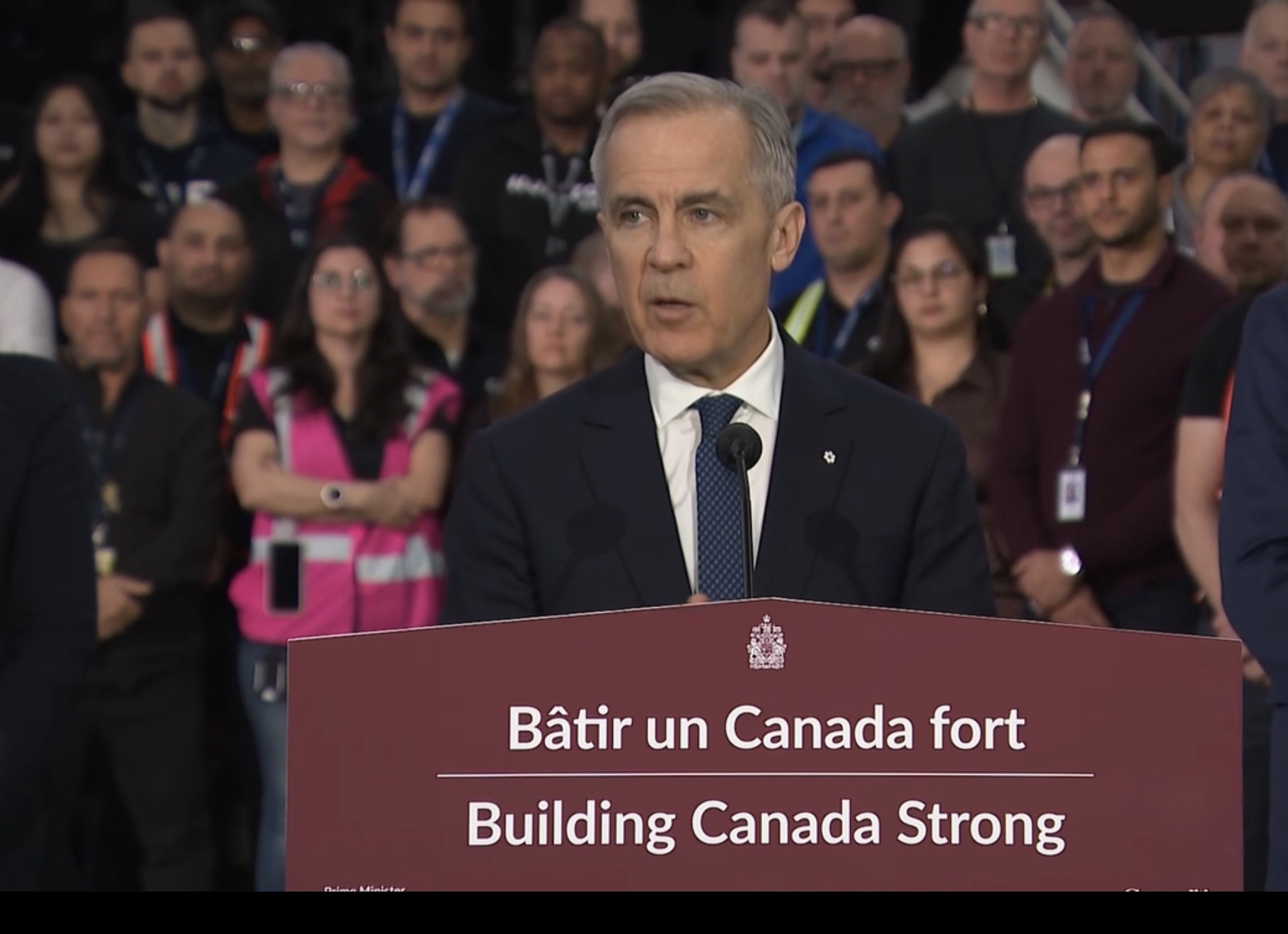
Below: The Prime Minister announcing the Defence Industrial Strategy
THE DEFENCE INVESTMENT AGENCY
Prior to developing the Defence Industrial Strategy, Ottawa consulted with 17 different countries that already have similar programs – learning how those countries have streamlined and improved their own procurement processes. It also consulted with industry, which expressed frustration with the both the time frames and the amount of bureaucracy involved with bidding to supply on federal contracts.
As a result of these consultations – and even prior to the DIS being rolled out – Ottawa announced the new Defence Investment Agency (DIA) on October 2, 2025.
“Canada’s defence procurement is currently fragmented across several departments, slow to consult industry, and too complicated to respond to rapidly evolving military needs – leaving the Canadian Armed Forces waiting years, sometimes decades for critical equipment,” said a news release from the Prime Minister’s Office announcing the new agency.
Carney also announced the appointment of Doug Guzman as Chief Executive Officer of the DIA. Guzman has three decades of high-level experience in finance and investment, including leadership roles at Goldman Sachs and serving most recently as Deputy Chair of the Royal Bank of Canada.
“This is a tremendous opportunity for partnership between government and businesses,” said Guzman. “All at once, we can drive investment, strengthen our national security, and meet our international commitments. We will bring speed and simplicity to the process of arming our military, while building Canada’s industrial capacity.”
Prime Minister Carney stated the DIA would be playing a critical role at a critical time.
“In a dangerous and divided world, Canada’s new government is ensuring the Canadian Armed Forces get the equipment they need, when they need it,” he said.
RAPID IMPLEMENTATION
Since the announcement of the Defence Industrial Strategy earlier this year, Ottawa has been following through on its pledge to reduce red tape and shorten timelines. One such example was the RED COBALT Uncrewed Systems Accelerator 2026, which brought together leading members of all Canadian armed services with companies working on solutions in August of 2026. It was an opportunity for hands-on demonstrations of the latest in drone, counter-drone and ground robotics technologies. InDro Robotics was one the many companies demonstrating or exhibiting solutions. We wrote about that event here.
One month earlier, the Defence Drone Initiative (DDI) was announced. Led jointly by the Department of National Defence and the Defence Investment Agency, the DDI is identifying specific solutions Canada needs – and ramping up the speed at which qualifying Canadian companies can start working on solutions.
The DDI has multiple initial priority areas, including low-cost tactical intelligence, surveillance and reconnaissance drones, and Uncrewed Ground Vehicles (UGVs) for logistics and complex terrain. After reviewing applications from hundreds of Canadian companies, the DDI has determined a much smaller number of firms, including InDro Robotics, meet the criteria as a “Qualified Supplier” for all five current streams. The designation places these companies in an optimal position to develop and bid on high priority solutions.
The speed at which all of this is taking place – along with the key role Canadian innovations will play – was recently emphasised by Defence Minister David McGuinty. In a keynote speech opening the 2026 GCXpo, McGuinty made it crystal-clear we are in a new era; one where partnerships and speed are of paramount importance. Here’s his speech:
INDRO’S TAKE
As a Research and Development company, InDro has always had to be agile. Meeting milestones and other deadlines is very much part of our company ethos.
And so is Canada. We are proud to offer world-class, Made-in-Canada solutions – and this extends to the new Defence Industrial Strategy, the Drone Defence Initiative, and whatever else comes in the months and years ahead.
“InDro has carried out multiple previous contracts for the Department of National Defence, creating dual-purpose solutions that can serve our military while also having use-cases on the civilian side of things,” says InDro Founder and CEO Philip Reece.
“We fully understand that Canada and Canadian technology firms are now in a new era – where even greater speed and the very latest technologies will play critical roles in our defence and sovereignty. When it comes to drones, ground robotics and AI, we are ready for that challenge.
“And, as a Canadian company, are proud to help serve this country’s needs.”