
By Scott Simmie
Barely a day goes by without a new video popping up on LinkedIn or YouTube, showing off the capabilities of a new humanoid or quadruped robot.
The videos can be spectacular: Robots performing seemingly-impossible jumps, scrambling up and down rugged inclines, performing martial arts – even folding laundry. Just a few days ago, two different Chinese-made robots beat Usain Bolt’s 100-metre world record. During one heat, a robot called “Lightning” clocked in at 9.39 seconds. Bolt’s 2009 record, which still stands (for humans), is 9.58 seconds. So at least two humanoids can run faster than the world’s fastest human.
The impression left by such feats is that we are truly entering a world where robots – particularly humanoids – will soon be commonplace in factories, homes, and even delivering goods on the streets.
But are we? We’ll dive into that topic today. Specifically, we’ll look at predictions for the growth of robotic adoption in the coming years.
First, though, a look at that incredible run by Lightning, built by Chinese phone manufacturer Honor for a robotic games competition.
NOT SO FAST
Lightning is pretty impressive. But that speed doesn’t mean humanoids are ready to be deployed at scale.
Currently, companies interested in humanoids are generally trying them out on a one-off basis or using them for R&D. That means testing their capabilities, usually in a factory setting, with a specific task. Usually those tasks require significant training in simulation and additional coding before they can be deployed. And even then, no humanoids we’ve seen can perform with anything like the speed and intuition of a human being (though we will give a medal to Lightning for that 100m run).
Humans are, obviously, incredibly complex. We make our own calculations, at lightning speed, every single time we reach for an object and move it. Our own “sensors” – ranging from our eyes and ears to the nerves in our fingertips, muscles etc. – provide constant feedback as we grasp or manipulate an object. We can also take verbal directions and process them quickly. We can collaborate with a co-worker simply by asking them for some extra help. And we can hear or see unanticipated events and react quickly.
Humanoids will reach those capabilities someday (and we have one client who plans to deploy one for simple tasks in a radioactive environment). But there’s still a ways to go before they reach their full potential.
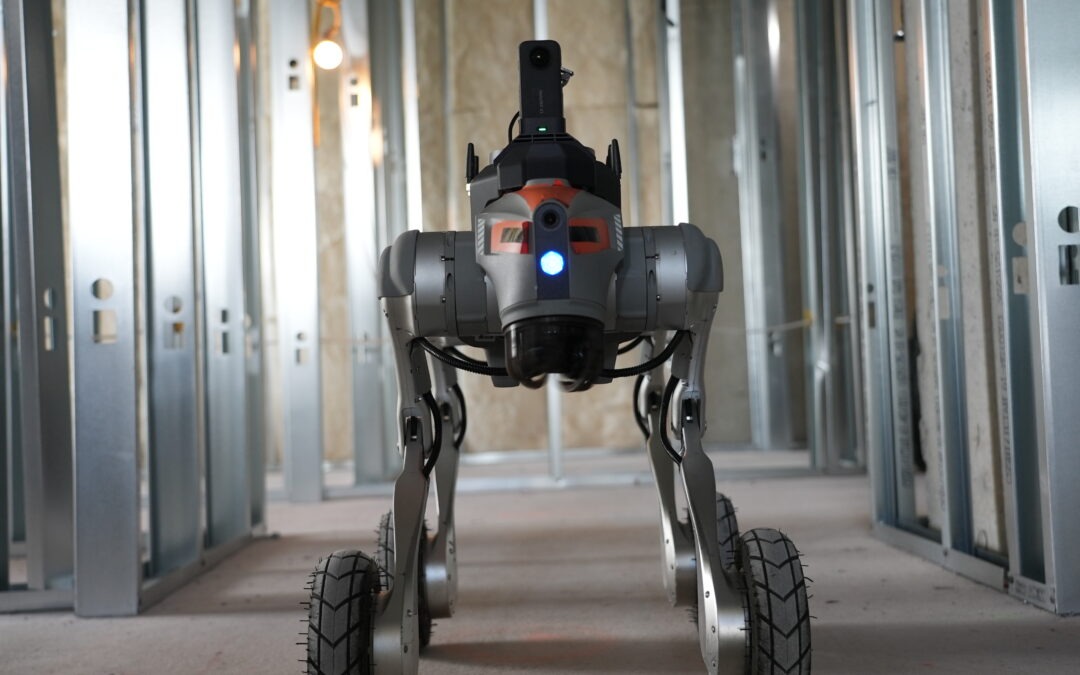
In the meantime, many other types of robots prove daily they can carry out useful tasks. Robotic arms can pick-and-place even heavy objects and never get tired. Autonomous Mobile Robots can move heavy loads across a factory floor. Quadrupeds like InDro Prowler can carry out inspection or security patrols (some are even deployed in a museum to keep watch after-hours). The Cypher Robotics Captis system can count inventory in massive warehouses.
But such robots are still far from ubiquitous. The real wave, the shift toward robots becoming a regular part of the scene in the workplace – and eventually in our lives – is still many years off.
PREDICTIONS
It’s easy to make predictions, and there are many of them floating around when it comes to robotics. One we find particularly well-researched was published August 16 of 2026 by J.P. Morgan, a global leader in investment banking services. While it’s bullish on robotics in general, it does offer some cautionary notes.
“In our view, the gap between a viral demo reel and a truly useful general-purpose robot remains quite wide—something investors need to appreciate,” reads this report. “The challenge lies in getting humanoids to perform a wide range of tasks safely, reliably and autonomously in an unpredictable world.”
Remember how we mentioned that humans make countless calculations per second? J.P Morgan cites research saying that even AI-powered robots capable of 2,000 trillion operations per second (TOPS) don’t come close to human capabilities.
“…All that brain power and processing ability only produces roughly 10% of what an average adult human brain could do – not enough yet to replace generalised human labor,” it states.
But it will someday get there – reaching a point where humanoids can not only perform alongside humans in unpredictable environments, but will be able to receive and understand verbal instructions via AI Large Language Models.
And the global predictions overall? J.P. Morgan suggests a major shift will come between now and 2035, growing from $100B US annual sales in 2025 to $2.5 trillion US by 2035. That’s an average annual growth rate of 35-40 per cent. It suggests autonomous vehicles (including cars, robotaxis etc.) sales could reach $750B US by 2035, or a little over one-third of that $2.5 trillion predicted total. The report does not separate out robotic arms, which have become a mainstay in many large-scale factories, particularly in the automotive sector.
We should also add J.P. Morgan suggests that $2.5 trillion may well be a conservative estimate. Those more bullish on the future predict the global spend could reach $8 trillion US by 2035. The report also suggests that China is particularly well-positioned, with three of the world’s largest humanoid manufacturers, as well as highly integrated supply chains.
As for InDro, we foresee a continual progression – which includes overcoming some hurdles along the way. We particularly like this video, created by Toronto’s Dr. Albert Chen, who has an incredibly impressive background in Engineering, product development and startups:
INDRO’S TAKE
We’re not surprised by the numbers suggested by J.P. Morgan’s analyst. Our own sales have increased significantly since we entered the ground robotics world. We are seeing strong demand for both R&D platforms – which ultimately lead to innovations that boost the industry – plus our own robots. We are also currently working on our most ambitious project to date: Turning the world’s longest-range hybrid vehicle (7,000km on a single tank of diesel) into a robot.
“InDro has designed and built robots for some of the largest technology companies in the world and is ideally positioned for the increase in global demand,” says InDro Founder and CEO Philip Reece. “When you add in Canada’s Defence Industrial Strategy and its emphasis on dual-purpose technology solutions, we – along with many others in this sector – are ready for the future.”